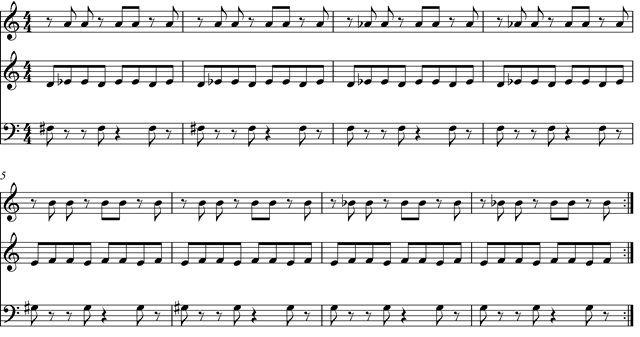
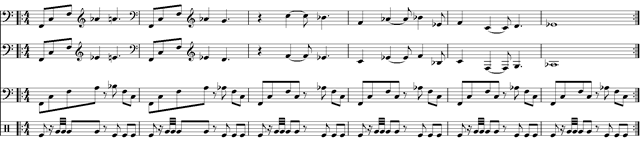
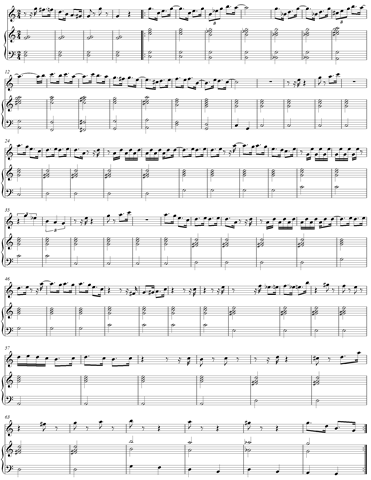
Monday, July 25, 2011

Changes coming!

So I have been away from analysis for a couple of months due to some other projects I have taken on.  However, recent events have gotten me excited about this blog and all the analysis I want to share with you.  The most exciting of which is an article I have published in a new academic journal in Germany: ACT, zeitschrift fur musik and performance.

Before I tell you about that, I would like to let you know what is coming around the corner (some of the changes you can already see).  I will be adding a pages bar at the top here with various resources the study and appreciation of game music theory.  This will allow me to get rid of all the extra fluff at the bottom of the page here and give a closer look at some of the terminology and analytical tools I use here or have come across.  Right now, you can see that I’ve posted a page with a list of books and articles discussing game music theory, with links when available.  This list is in its infancy and will grow extensively over the next month or two.  If you have a reference you’d like to add, you can comment below and I will include it.  I have many references already to add that I used in some of my articles and thesis but will be doing so when I have the time to format them correctly.

I will be finishing up my SMB2 series and will start on some other topics which I hope you will enjoy.  I will also be doing some reviews and commentary on game music theory publications as I come across them.  Until then, here is an the abstract to my article “Thematic Unity Across a Video Game Series” (you can read the whole article here):

Composer Koji Kondo’s music for both Super Mario Bros. (Nintendo, 1984) and The Legend of Zelda (Nintendo, 1986) is among the most recognized video game music ever written. Through the use of motivic and prolongational analysis, this article demonstrates how Kondo created a unity across the entire Zelda franchise, while making each game’s score unique by examining one musical element, the overworld theme, from each of the main entries in the Zelda series. Schenkerian analysis is used to identify structural and motivic relationships between the various themes. This article concludes with an examination of semiotic implications of this analysis and its impact on other as-pects of the Zelda series and game music analysis as a whole.

Monday, April 4, 2011

Chromatic Harmonies in Pac-Man

EDIT: Due to the original YouTube video being removed that this post was originally based off of, this post may be a bit confusing. I will attempt to get the music object notated and added to this post to make it easier to follow.

Yes, I said it: Pac-Man!  Not a game one would study much for music, since there is so little to be found in the game, but if you stop to look, you never know what you may find.  Below you find the introduction music from Pac-Man (at 0:20), which I am calling the “Game Start” object.

What I found was the interesting chords heard in the “Game Start” object.

Looking at the whole object, Roman numerals would make it I-bII-I-V7-I in B Major

Now there is a bit of logic to this if we dig deep enough (or I could just be making it all up).

In this case, the bII functions a bit like a dominant.  We can hear the E pulling down to the D# (E being the only diatonic pitch in this bII chord).  This allows us to establish B as our tonic pitch before hearing the implied V7 chord in measure 2.

On beat three of measure 2, we get ever so briefly an E over an F#, implying a V7, which re-enforces this idea that E is serving a tonally defining feature until the A# is heard at the very end of this object in the ascending passing motion between V7 and I.

So little music, but so much to uncover.  While I am primarily interested in analysis, a music historian might be interested in tracking the influence of such tonal devices through music of the 8-bit era.

Friday, April 1, 2011

The “Mario” Cadence

image
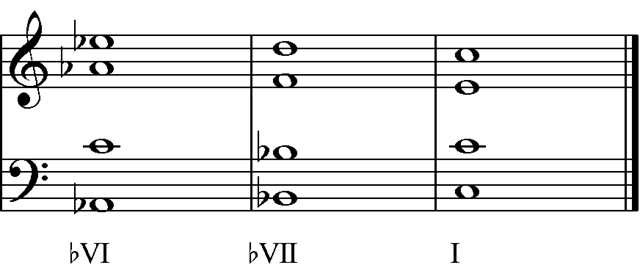
I will start off this post by saying that this cadence was not invented nor first used in Mario, however, it is found all throughout the music of Koji Kondo and others who were inspired by his music.
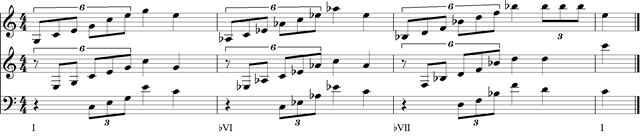
The cadence in question, is the one pictured above.  The motion of bVI-bVII-I.  The example above is given in C major with rather arbitrary voice leading.  For those of you who have memorized all your part-writing rules, you will notice this progression is nearly impossible to write without violating a convention or two (when writing in four parts).  You will notice from all the examples below, ascending parallel 5ths and Octaves are very common when writing out this progression.
In my master’s thesis, I briefly discussed the use of modally inflected harmonies used as substitutions for more traditional harmonies.  The following paragraphs are taken from that thesis, Examining Non-Linear Forms: Techniques for the Analysis of Scores Found in Video Games (Texas Tech University, 2009):
Walter Everett’s discussion of tonal systems in Rock music provides a great explication of the use of modal inflection in the language of popular music. He discusses six different tonal systems that he believes are prominent in the tonal systems of Rock music. The system that is dominant with the composers discussed here is his third system: “Major-mode systems, or modal systems, with mixture from modal scale degrees. Common-practice harmonic and voice-leading behaviors would be common but not necessary.”[1] This system allows for the substitution of chords from modally inflected scale degrees to function as their diatonic counterparts would.
For example, the music of the composers examined below frequently employ the aeolian bVII chord functioning as a substitute for a more traditional dominant chord, such as V or vii°. The bVII can be heard as a dominant chord because it retains the motion from scale degree four to scale degree three in a bVII-I progression. This is the same voice leading motion that governs the voice leading in the V7-I motion. The bVII removes the leading tone, but creates momentum through other voice leading tendencies.
We see the bVI lead often to the bVII in cadential motion. Björnberg acknowledges this cadential motion as frequently "replacing the iv-V-i cadence of ‘regular’ tonal minor.”[2] We see it often replace the IV-V-I cadence of “regular” tonal major as well. Not only that, but we also see an example of bVI alternating with I. Both of these are normal functions of a vi chord: substitution for the IV chord in a predominant function, as well as the expansion of a tonic area. The bVI makes a good substitute for vi because it retains the tonic pitch and interval relationship in size (though not quality). Its third relationship to tonic allows it to continue to function as a tonic embellishment. It functions in the cadence because it allows for a descending third progression from the lowered third scale degree. These modal chords retain the function of their diatonic counterparts, and can be understood as functioning like those chords, even though some of the voice leading conventions are removed or altered.
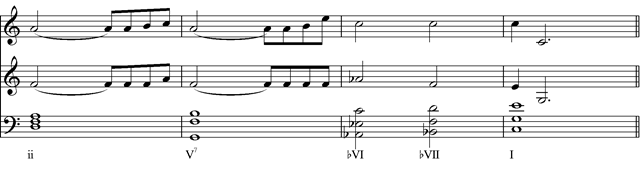
The most well-known example of this cadence in video game music is found in the Overworld Object to Super Mario Bros., hence the moniker “Mario” Cadence:
image


This particular cadence is used also in the fanfare for the end of each level:
image


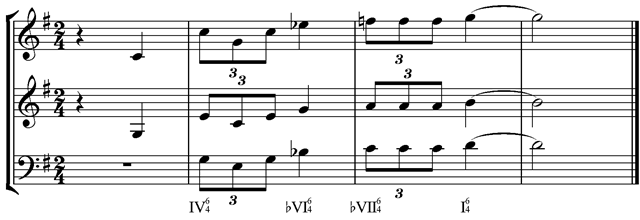
In the last post, I showed this example of the cadence in Super Mario Bros. 2:
image


Used as a common device for fanfares in the Mario series, we now see it used in Super Mario Bros. 3 Airship Victory Fanfare:
image


This harmonic language was not restricted to the Mario games from the NES era, as we can hear in the Dire, Dire Docks object from Super Mario Bros. 64:
Harmonic Progression: I | bVII | I | bVII | bVI | bVII | I

In fact, much of the A section of this object follows that progression.  When the bVI enters into the progression, the sense of cadence, or at least tonal center, becomes solidified.
Finding this cadence all throughout this music makes us wonder about its power and how it works.  It lacks a clear leading tone and dominant/tonic relationship, yet it draws our ears towards tonic in a way that no classical cadence does.
Cruise Elroy posted on this cadence back in 2008, which can be viewed here.  He does an analysis of three Ocarina songs from The Legend of Zelda: Ocarina of Time, which have this cadence in them, and also shows us an example of this cadence in Super Mario Galaxy.
For now, this progression will be coined the “Mario Cadence” and will be identified as such until better nomenclature is developed or found.

[1] Walter Everett, “Making Sense of Rock’s Tonal Systems,” Music Theory Online Vol. 10, No. 4 (December 2004), http://mto.societymusictheory.org/issues/mto.04.10.4/mto.04.10.4.w_everett.html.
[2] Alf Björnberg, “On Aeolian Harmony in Contemporary Popular Music,” Typescript, http://www.tagg.org/others/bjbgeol.html.
Sunday, March 20, 2011

Super Mario Bros. 2 Analysis – Ending (Part 1)

This object is in two parts, but there is so much to discuss about the first part that I am splitting up into two posts.

As a refresher, here is what the object sounds like:

Now that you have that in your inner ear, lets dive into the music, shall we?

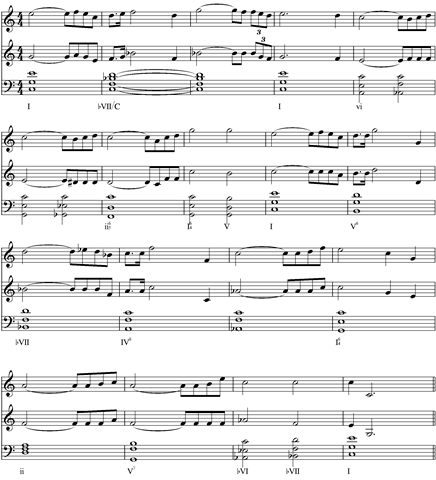
image

This object is full of interesting harmonic shifts.  Right from the beginning, we notice the composers use of the bVII as a dominant substitution.  There is also a presiding C pedal throughout the opening from Measure 1 through Measure 8, until the unmistakable dominant chord in measure 8 is heard.

Measures 5-7 present an interesting shift of harmonies through chromatic voice-leading.  This motion connecting the a minor (vi) chord to the d minor-seventh (ii7) is accomplished through descending half step motion and one diatonic neighbor motion (C-D-C in m. 5-6).  This allows for some harmonic instability while maintaining a good sense of voice leading and interest in this three-part object.

The final cadence of this excerpt is also interesting, and one which I will devote a future post to, but it is a very popular cadence in Mario music from the first game up through Mario Galaxy.  This “Mario Cadence” consists of taking the Submediant and Subtonic chords from the parallel minor and cadence on a major tonic.

There are some distinctly classical elements to this object as well.  The chromatic voice-leading from m. 5-8 embellish what is a textbook chord progression ending with a cadential six-four motion into an imperfect authentic cadence.  This part of the object could be described as a contrasting period:

A: Measures 1-8
Ends in an Imperfect Authentic Cadence (melody ends on Mi, not Do)

B: Measures 9-18
2 Measure extension through sequencing.  Ends in a Stronger Cadence than (A) since the soprano ends on Do.  I would argue that the bVII serves as a convincing enough dominant substitution that this is infact a stronger cadence than the one before it.

Analysis of Part 2 of this object is forthcoming.  There is a dramatic change in register and style.  Also look forward to an examination of the “Mario Cadence” as well as some thoughts on Semiotics and Video Games.

Friday, January 7, 2011

Super Mario Bros. 2 Analysis - Boss

Now do a Harmonic Analysis…

image 

Not that simple, is it?  The biggest challenge is to figure out which note in the second voice is the chord tone, and which one is not.  Lets look at the possibilities for measures 1-2:

[Upper Note is Non-Chord Tone] We have F#, D and A.  A perfect D Major Triad.

[Lower Note is Non-Chord Tone] We have F#, Eb(D#), and A.  The spitting image of a D# diminished triad, or F# diminished seventh.

If you follow this logic out, you have these tow possibilities for the progression:

imageProgression one is an alternation of Major and diminished triads.  Progression two is the alternation of Fully-diminished and half-diminished triads.

The fact of the matter is that neither of these options is satisfying.  This object hinges on the dissonance created by the half-step when combining these two option.

No description really does these chords justice.  They are set classes (0147) and (0136) alternating.  One certainly has a more “Major” quality to it while the other is more diminished sounding, due to the quality of the intervals present.

Either way, great way to represent the conflict of a boss battle, buy having the most dissonant interval define the quality of the sound.

And for those fans of Video Game Music Remixes:

Tuesday, December 14, 2010

Super Mario Bros. 2 Analysis - Underworld

Six Measures, Layers of Excitement.
image
This little melody is quite a little complex puzzle, and by no means to I consider my interpretation absolute.  I’d love to hear other views as well.
Starting on a large, macro level, this melody is all f minor with a minor 7th.
image

While some of the melodic harmonies do not always line up with this interpretation, most of the structural elements do. 
If we peal back one layer, we will notice that the object is oscillating between fmm7 and cmm7.  The F pedal, due to the persistent bass line, is heard under the cmm7.
image

The Bb in the first measure causes some problem with this interpretation.  Why, when all the other five measures of the bass line would this Bb occur here.  Well, if the Bb were replaced with an Ab (like the other measures), there is a distinct localized clash between F major and F minor.  In the other 5 measures the Ab is heard as a pedal harmony, but in the first measure, it would have been heard directly related to the melodic harmony and caused an audible dissonance that just sounds wrong.
Notice how this underworld theme is so short.  You might recall that Super Mario Bros. also had a rather short underworld theme.  These themes are slow, with minimal harmonic movement.  They are designed to drive you crazy, just like the underworld areas are designed to be a bit darker than your typical overworld area.

Wednesday, October 20, 2010

Super Mario Bros. 2 Analysis - Overworld

Now onto the meat and potatoes of this game: the Overworld Object.
This object is the longest out of the bunch, and is a very interesting object harmonically.  Below I’ve provided the melody line with a harmonic reduction below.
image
This object is divided into four distinct sections:
Introduction (mm. 1-4): Sustaining dominant harmony G
Section A (mm. 5-20): A 16 measure period (some theory texts would describe this as a sentence) centered on the tonic C
Section B (mm. 21-52): A parallel double period also centered on C.
Section C (mm. 53-68): Two phrases using a circle of fifths progression to travel form E to C.
Section A has the most interesting set of harmonic motions.  Using parsimonious voice leading, this phrase travels from C, to Eb+, to gm, then lastly to A7.  This is accomplished with the bass opening fifth C-G.  While the G is maintained, the lowest note drops a half step each time the harmony changes.  The soprano voice parallels this motion from E to C#.
The A7 then moves to F major.  If you ignores the seventh on the A chord, you could relate these two triads with transformational theories: R(P(Amajor))=Fmajor.  We could also bring in some sort of split/fuse transformational theory, but I’ll leave that for now. 
(NB: refer to terms defined at the bottom of the page for information on Transformational theories)
If we start thinking big picture, it is interesting to note that the F major then moves to C major in a reverse of the Character Select Object introduction.
C then moves to A (an RP transformation) to start a circle of fifths progression back to C.
Section B is not nearly as harmonically exciting, with a repetition of the chord progression I, V/V, V7, I twice.  The harmonic rhythm slows to one harmony per four measures
Section C is more of the same, as C transforms to E (LP transformation) then follows a circle of fifths back to the dominant G, which sets up the loop back to Section A.
While slightly out of order, it is interesting to note the expansion of the circle of fifth progression in this object.  Section B uses D to G to C; Section A contains A to d to G to C; then finally Section C starts at E to a to D to G (ultimately back to C).  D and A also have fluctuating qualities throughout.
Is this the time to bring in theories of non-linear time in music?
I’ll save that for later!