Showing posts with label The Legend of Zelda: The Adventures of Link. Show all posts

Tuesday, November 15, 2011

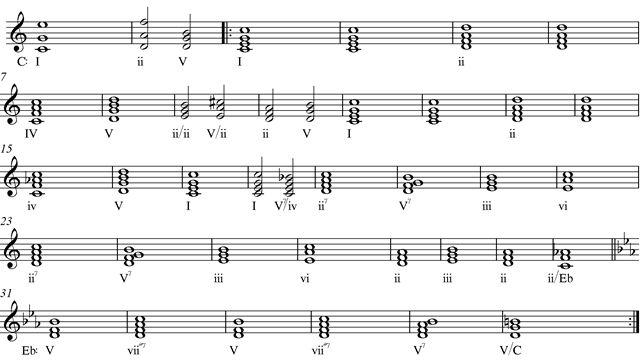
Adventures of Link Analysis: Town Music

image

This object is relatively straight forward.  There is occasional modal mixture with the infrequent use of the F minor chord. 

The brief trip to Eb at the end of the object is perhaps the most interesting segment.  I am a little disappointed that the only chords we get in this key are dominant chords and we never get a firm Eb.  I would argue against a key change here, but the key relationships between C and Eb are interesting for us Riemannians (it is a stacked transformation: parallel then relative).

The most interesting harmonic shift is between the last two chords of the object.  A V7 in Eb moving to a V in C.  This is an amazing voice leading phenomenon that seems to parallel the key relationships between these two. Since we are going from the V in the key of Eb, to the V in the key of C, we have to perform the transformation in reverse (relative then parallel):

So our base triad the first chord it [Bb, D, F]

R[Bb, D, F] = [G, Bb, D]
In a relative transformation, the chord is transformed into its relative key.  So in the case of Bb Major, it is transformed into G minor.  This is done by having the top note moved up one step. If the chord were a minor chord and being transformed by a relative transformation, the bottom note would move down one step.

P[G, Bb, D] = [G, B, D]
A parallel transformation takes a chord and transforms it to its parallel major/minor by moving the third a semi-tone in the appropriate direction.

Now, the seventh of the chord, A, does what it naturally wants to do, drops to the G.  That release of tension combined combined with the smooth voice-leading in the rest of the chord makes this key transition smooth as butter.

Saturday, October 8, 2011

8-Bit Zelda Title Themes: A Comparative Analysis

This post was originally intended to be an analytical look at the Title music from The Legend of Zelda: The Adventures of Link, but in doing the analysis, there is just too much to discuss when looking at these two objects together.  As a refresher, here is the Title Music from The Legend of Zelda:

… and the title music from The Legend of Zelda: The Adventures of Link:

The LoZ title music is structured in the following format:

4 measure intro | 6 measure bridge | 8 measure Phrase A | 12 measure Phrase B

In contrast, the LoZ:AL title music breaks down as follows:

4 measure lead in | 8 measure intro | 4 measure bridge | 8 measure Phrase A | 8 measure Phase B

There are some similarities here.  Each object contains two primary phrases of music, with an introduction and a bridge from the intro into the main melodic statement.  On first listen, these two objects appear to have very little in common…

… however…

If you look at the harmonies implied in the introduction phrases, you get the following (harmonic rhythm is one chord per measure):

LOZ – Bb | Ab | Gb | F
LOZ:AL – G | F | Eb | D | G | F | Eb | D

Roman Numerals: I – bVII – bVI – V (– I – bVII – bVI – V)

Each of these objects is built on this descending sequence of chords through a modally mixed scale.

Each object uses this progression differently.  In LOZ, the pattern is used again at the beginnings of both Phrase A and B, but then moves to different related harmonies. 

LOZ:AL is entirely based on this progression.  Phrase A emphasizes I, using bVII as a dominant functioning chord, and Phrase B alternates between bVI and V. 

These harmonies are ingrained in the harmonic language of music written by or inspired by Koji Kondo.  I could reference other examples here, but I’ll save it for another day.

Now listen to the two objects again.  Can you here the remarkable similarities?

Monday, July 25, 2011

Changes coming!

So I have been away from analysis for a couple of months due to some other projects I have taken on.  However, recent events have gotten me excited about this blog and all the analysis I want to share with you.  The most exciting of which is an article I have published in a new academic journal in Germany: ACT, zeitschrift fur musik and performance.

Before I tell you about that, I would like to let you know what is coming around the corner (some of the changes you can already see).  I will be adding a pages bar at the top here with various resources the study and appreciation of game music theory.  This will allow me to get rid of all the extra fluff at the bottom of the page here and give a closer look at some of the terminology and analytical tools I use here or have come across.  Right now, you can see that I’ve posted a page with a list of books and articles discussing game music theory, with links when available.  This list is in its infancy and will grow extensively over the next month or two.  If you have a reference you’d like to add, you can comment below and I will include it.  I have many references already to add that I used in some of my articles and thesis but will be doing so when I have the time to format them correctly.

I will be finishing up my SMB2 series and will start on some other topics which I hope you will enjoy.  I will also be doing some reviews and commentary on game music theory publications as I come across them.  Until then, here is an the abstract to my article “Thematic Unity Across a Video Game Series” (you can read the whole article here):

Composer Koji Kondo’s music for both Super Mario Bros. (Nintendo, 1984) and The Legend of Zelda (Nintendo, 1986) is among the most recognized video game music ever written. Through the use of motivic and prolongational analysis, this article demonstrates how Kondo created a unity across the entire Zelda franchise, while making each game’s score unique by examining one musical element, the overworld theme, from each of the main entries in the Zelda series. Schenkerian analysis is used to identify structural and motivic relationships between the various themes. This article concludes with an examination of semiotic implications of this analysis and its impact on other as-pects of the Zelda series and game music analysis as a whole.