Wednesday, October 20, 2010

Super Mario Bros. 2 Analysis - Overworld

Now onto the meat and potatoes of this game: the Overworld Object.
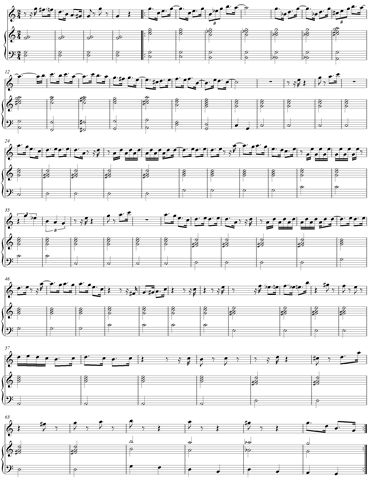
This object is the longest out of the bunch, and is a very interesting object harmonically.  Below I’ve provided the melody line with a harmonic reduction below.
image
This object is divided into four distinct sections:
Introduction (mm. 1-4): Sustaining dominant harmony G
Section A (mm. 5-20): A 16 measure period (some theory texts would describe this as a sentence) centered on the tonic C
Section B (mm. 21-52): A parallel double period also centered on C.
Section C (mm. 53-68): Two phrases using a circle of fifths progression to travel form E to C.
Section A has the most interesting set of harmonic motions.  Using parsimonious voice leading, this phrase travels from C, to Eb+, to gm, then lastly to A7.  This is accomplished with the bass opening fifth C-G.  While the G is maintained, the lowest note drops a half step each time the harmony changes.  The soprano voice parallels this motion from E to C#.
The A7 then moves to F major.  If you ignores the seventh on the A chord, you could relate these two triads with transformational theories: R(P(Amajor))=Fmajor.  We could also bring in some sort of split/fuse transformational theory, but I’ll leave that for now. 
(NB: refer to terms defined at the bottom of the page for information on Transformational theories)
If we start thinking big picture, it is interesting to note that the F major then moves to C major in a reverse of the Character Select Object introduction.
C then moves to A (an RP transformation) to start a circle of fifths progression back to C.
Section B is not nearly as harmonically exciting, with a repetition of the chord progression I, V/V, V7, I twice.  The harmonic rhythm slows to one harmony per four measures
Section C is more of the same, as C transforms to E (LP transformation) then follows a circle of fifths back to the dominant G, which sets up the loop back to Section A.
While slightly out of order, it is interesting to note the expansion of the circle of fifth progression in this object.  Section B uses D to G to C; Section A contains A to d to G to C; then finally Section C starts at E to a to D to G (ultimately back to C).  D and A also have fluctuating qualities throughout.
Is this the time to bring in theories of non-linear time in music?
I’ll save that for later!

Friday, October 15, 2010

Super Mario Bros. 2 Analysis – Character Select

In continuing with my analysis of Super Mario Bros. 2, let us now turn to the Character Select music.

This bouncy little tune is an interesting study in voice leading.  With only three lines of pitch available to the composers of NES tunes, there comes a big challenge with voice leading and doubling within the parts.  They can, however, use the limited number of vertical pitches to phase in and out of different harmonic implications. 

In this score, the bottom staff represents the implied bass line and contains a harmonic analysis.  Only the upper three lines are the pitches of the music object.  They will be referred to as Soprano, Alto, and Bass throughout the analysis. 

image

For an example of the voice leading/doubling challenge, lets take a look at the fourth measure.  Here sits a typical V7 chord that is desiring to go to the tonic.  The soprano line uses a classical ornamental figure of an appoggiatura to add variety to the line.  The intrigue here is in the alto line. Coming out of the descending chromatic line, the alto briefly jumps up to a B before jumping back down to the F.

It was important for Kondo to create the sense of dominant on the downbeat of the fourth measure.  To do that, especially after the chromatic passing motion in measure two, he had to establish the interval of a major third over the bass note G.  This allows the appoggiatura to be effective, ensuring E does not belong in the chord.  Had he stayed on the F (as one might do if there were four parts involved), the pitches on the downbeat would be E, F, and G.  Though the outline of the dominant seventh is there, it lacks the tonal pull of the leading tone B which defines the function of this harmony.

However, Kondo wanted to maintain the pitch framework from the opening three measures in the measures following.  You will notice that measure 1-3 contains the alto pitches G, F#, and F.  These are also the pitches in measures 5-7.  To get back to the G, without leaving the leading tone hanging in measure F, Kondo frustrated the B back down to the F (seventh of the chord) to which then rises back to G.  To make up for the missing third, the bass jumps up to provide the leading tone. This is effective because the bass note G will ring in our inner-ear throughout the measure until replaced by the root of the tonic chord.

image 

The other interesting area of this music object occurs at the end.  The form of the object is as follows (each section is four measures long):

Into-(A-A-B-B’)

The two A sections are identical in every respect.  The B sections is built on this idea, however, the second section includes an obbligato soprano line which bounces all over the pitch spectrum.  Though harmonically they function identically, Kondo plays with the alternation of F and F# between these two phases creating different qualities of the harmony.  Though the circle of fifths progression is still the same, its qualities are colored by this chromatic alteration.

For example, m.16 is a dominant harmony, but the use of the F# in the alto line moves us into a b minor sonority briefly, or perhaps a GMM7.  However, the obbligato firmly plants us on a V7 chord in m.20.

Likewise, m.15 uses a V/V to introduce the dominant chord, but this V/V starts as a ii in m.19 due to the fluctuation of this pitch.

Too bad when the game is actually being played that this music is rarely heard completely.

Saturday, September 18, 2010

Reuse of Themes

Video game series often recycle themes from game to game to keep the continuity.  There are games, like Super Mario Bros., who reuse particular themes to create a sense of nostalgia.  The main theme from the original Super Mario Bros. returns frequently throughout the game series but always using it to generate this idea of something from the past.

The Legend of Zelda is another series that recycles themes.  As many of you know, the main theme for each Zelda game is typically different than the last, but retains motives and elements from previous themes to create the continuity of the series.  I’m currently playing through Twilight Princess and have found that the wolf songs uses to obtain the Hidden Skills are recycled ocarina songs from Ocarina of Time and Wind Waker. 

These themes have no meaning except for acquisition of hidden skills.  They don’t seem to relate to the individual skill because they don’t always happen with the same skill. 

I have not noticed if they somehow relate to the area where the howling statue is found.  They could also be an indicator as to the timeline of Twilight Princess in relation to Ocarina.  Are these memories of legendary songs of old? What about the Wind Waker song?

The seven wolf songs are presented in the video below.  The order of the songs is reproduced below the video.  Why these songs?  Well, I guess that is a bit less music theory and maybe I’ll leave that discussion up to the narratologist.  I should just sit here and try to ignore the fact that the wolf is terribly out of tune and needs to go back to aural skills.

1 - Song of Healing
2 - Requiem of Spirit
3 - Prelude of Light
4 - Zelda's Lullaby
5 - Song of Heroes
6 - The Wind Waker: Song of Gales
7 - Ballad of Twilight

Thursday, July 8, 2010

Super Mario Bros. 2 Analysis – Title Music

Now that my masters research is completed, turned in, published, and presented at a regional music theory conference, it is time to move on.  I have recently become attracted to the music of Super Mario Bros. 2 (NES, 1988) for several reasons.
  • The game is not the “real” Super Mario Bros. 2.  It is a “Mario-tization” of Yume Kojo: Doki Doki Panic, a Japanese game for the NES.  They did not get our version of SMB2 until 1993.
  • The music is composed by ???.  Some sources say Kondo is the actual composer of SMB2, but other sources (namely a soundtrack and various bios) claim that Hirokazu Tanaka is the actual SMB2 composer.
  • The Title Music…
Which brings me to a look at the Title Music for SMB2. 
image
This score separates the four tracks of the SMB2 Title Music.  I have linked a YouTube video below of the audio and corresponding visuals to this tune.
The first thing to recognize with this is the obvious remix of the Water World Music from the first SMB. Check the video below...
This is the main reason this tune first caught my attention.  Why would the Water World music, a relaxing tune to reflect the music of swimming through dangerous waters be reworked as a title theme?  It is worth pointing out that the first SMB did not have a title theme, so what are title themes for anyways?  Hard to tell how this tune fits into the whole picture until we see the whole picture (we’ll get to that much later).
As for how the tune works, it actually has some interesting elements to it.  What sounds like a simple oscillating Dominant-Tonic bass line is actually colored by some very interesting chords.
image
Above is the harmonic profile of this tune.  The numbers underneath the chords refer to the measure numbers that the harmonies support.  Lets walkthrough these harmonies and what they are doing:
Introduction
1-5: G Major (V) – dominant introduction leading to tonic of theme
Phrase A
6: C Major (I) – tonic chord
7: Technically a G Augmented Triad – the composer is creating a “dominant-like” chord here by flatting the root and third of the tonic triad, and grounding the harmony on the dominant G.
8-10: C Major (I) – a return to tonic
11: See 7
12-13: C Major (I) - a return to tonic.
Phrase B
14: G Major (V) – shifting tonal areas to G for a quick emphasis on Dominant
15: Like 7 and 11, this chord tries to create a sense of dominant, but this time all three notes of the tonic triad are flattened to create a Gb or F# Major triad.  This could also be seen as a D augmented with an added 7th, which would explain why it sounds so similar to the earlier G Augmented triad (even though the overall harmony is strictly major).
16-18: G Major (V) - Instead of repeating the same harmonic motion as before, this time, the tune stays on G Major.
19: GMm7 (V7) - A seventh is added to create a dominant seventh to return us to tonic.
20: C Major (I) - Tonic.
21: G Major (V) - Dominant “tag” to lead us into a new section of the tune.
Phrase C
22: C Major (I) – starting the new section firmly in tonic.
23: G Major (V) – moving quickly to dominant
24: G Diminished – By flatting the third and the fifth of the dominant triad, the music continues its downward spiral.
25: C# diminished - The Db, now C#, creates a new triad that leads cleanly into D minor.
NOTE: 24 and 25, could most likely be read as a G Fully Diminished 7th chord, but this reading reflects the notes and bass lines that predominate.
26: D minor (v/V) – starts a new downward decent.
27: F Augmented – By dropping the root down a half step.
28: F Major (IV) – Which brings us back in to traditional harmonic motion.
29: G Major (V)
30: C Major (I)
31-32: G Major (V)
33-36: C Major (I)
What is interesting to me are the similarities between Phrase A and B, even though the outlined chords are different qualities.  Having an Augmented chord build on scale degree 5 vs. a Major VII and how they seem to function the same.  Also in Phrase C, the downward motion happens twice, and each time it is handled differently, but to basically the same effect.
Does this make you want to go pull up some vegetables and throw them at the nearest shy guy?

Tuesday, September 22, 2009

Death and Defeat, Part 1

I have become increasingly interested in the portrayal of death and defeat through music in video games. That has prompted this series.

Death in The Legend of Zelda for the NES meant starting over from the very beginning of what ever you were doing. On the overworld, you returned back to the first area, even if you were clear to the other side of the map. In a dungeon, you have to return to the first screen, with many of the enemies you previously defeated back.

When you die, a spiraling scale downward mickey mouses the action on the screen. The player is then treated to this lovely tune, hereafter called the Game Over object.


Within the context of the game, this tunes comes off as a modally ambiguous G-minor. The D-G fifth at the loop grounds G as the tonally centric pitch of this phrase.

The interest is in how this relates to the end game. This quasi G-minor turns quickly in to C Major with the addition of a upbeat bass line. In a musically symbollic gesture, the Game Over object is defeated by the C major victory key. The only other instance of C in the game is the fanfare when Zelda herself is rescued just prior to the end credits.


Looking backwards, Game Over object, and the use of the same melody at the beginning of the End Game object could be representative of completion. In one instance, the player is defeated, and is left in a tonally ambiguous state. The game is effectivly over unless the player wants to try again. On the other hand, the player has achived the final goal of the game, where this melody is a signal that the game has ended.

The End Game object can be viewed as a variation or extension of the Game Over object. Harmonically, they are both based off the same ground, and even have some of the same modal inflections (a flat third and sixth scale degree of C). After hearing the End Game object, the Game Over object seems a bit clearer in terms of harmonic underpinning. However, with the Game Over object frequently heard next to the Overworld object (a modally inflected Bb) and the chromatic Dungeon object (posessing the same D-G fifth that informed the initial reading of the Game Over object), a consistant harmonic hearing of this phrase is constantly destabilized.