Thursday, March 8, 2012

Map Music: SMB3 – World 8

image

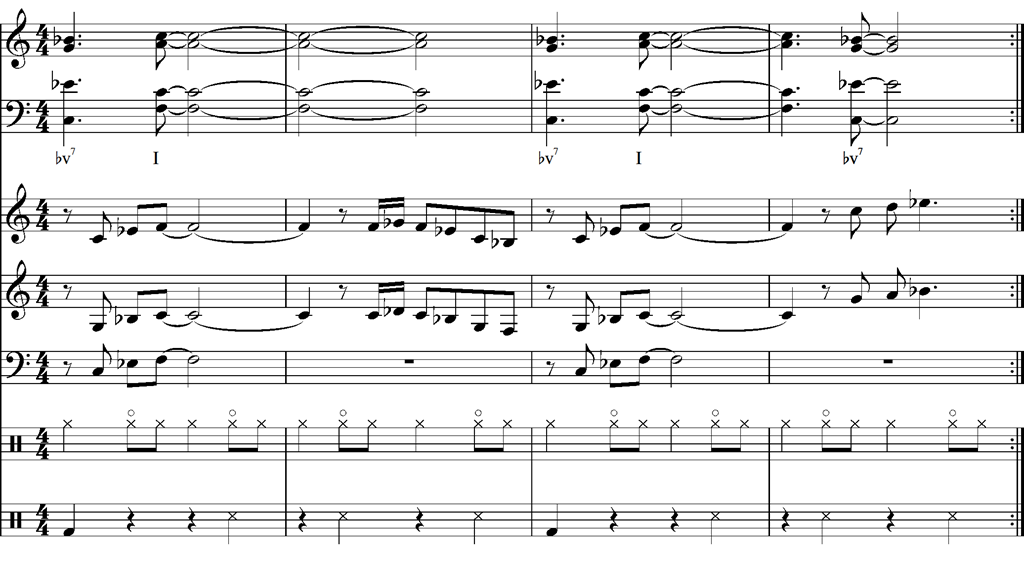
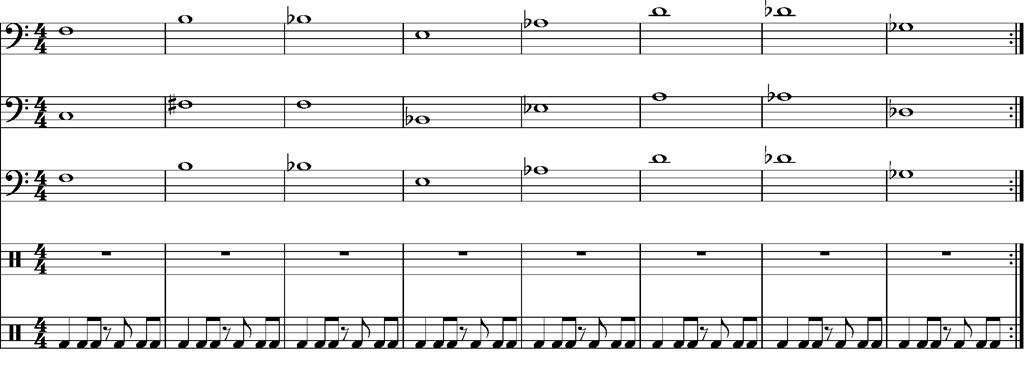
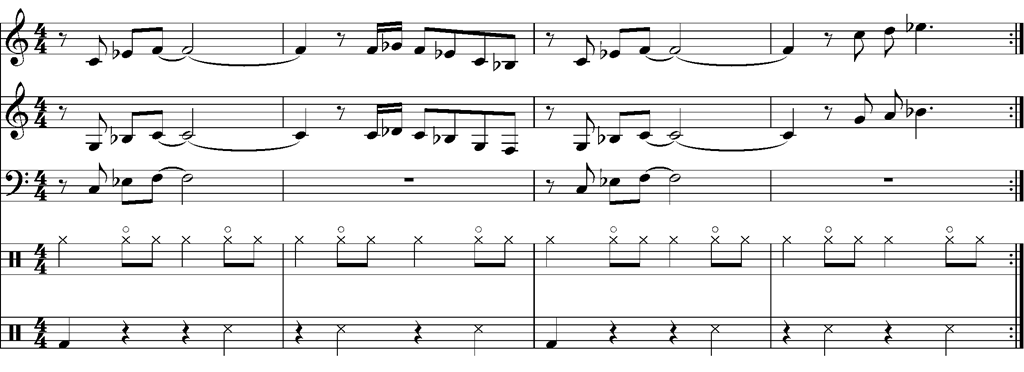
So just three lines here.  The Triangle Wave and one Pulse wave track are identical in pitch and register (slightly different timbre). 

I am mostly interested in intervals with this object.  The object can be heard as centered around F.  The half step decent at the repeat from Gb to F draws us back to F as our tonic pitch.

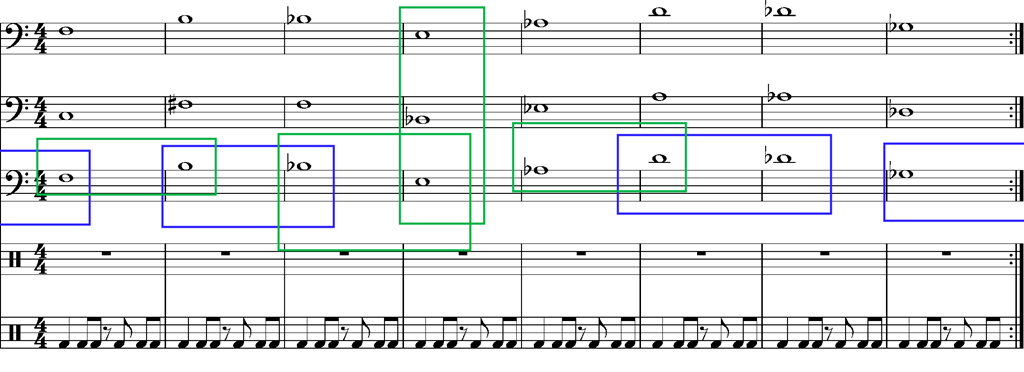
In the score below, I have boxed several intervals.  All the blue boxes are half step motions and the green boxes are tritones.  Notice how all the intervals between the lines (vertically) are P5s except for measure 4, where they chose to use a tritone.
image

So some very interesting patterns here.  Measures 1-3 and Measures 5-7 are transpositions of each other of ic3.  Measure 8 leads back to m1 with a semitone descent.  So how does measure 4 set up measure 5?  Well, there are two prominent harmonies that contain tritones: diminished chords and dominant 7th chords.  If this were a dominant 7th (C7), we would expect the following chord to have something to do with Tonic.  We could hear it as a i7 chord.  However, it most likely has a function akin to a diminished or diminished 7 chord, which is used often to modulate from one section to another since they can resolve in so many different ways. I can easily hear measure 3 as a edim7 to an Ab triad.

So what can be learned from looking at all these map objects together?  Is there something on a higher level that connects these objects together?  That and more coming soon!
Tuesday, March 6, 2012

Map Music: SMB3 – World 7

As we continue with our series on Super Mario Bros. 3 Map Music objects, we come to this lovely tune.  Though its written rather straight here, the tune is heavily swung in reality.

image

So this is a great little object.  Makes you feel like you are in a smooth jazz club sipping on a drink, enjoying the combo playing on stage.  At first I looked at this and did not see anything terribly interesting.  The object is a lot of open fifths.  So I set out to look at key and harmony.

By looking at the bass line, you can discern that the object is in the key of F.  C moving up to F is a great fifth motion to imply a dominant-tonic relationship.  The addition of the Eb seems natural for this music as often as we have seen the use of the bVIII functioning as a dominant harmony.  I tried looking at the pitches between the two lines, but there is nothing really to note.  At the core, it’s a feeling of F major with a lot of jazz color thrown in the mix.

So I set about harmonizing the piece with chords of my own.  I’m still playing around with some different options, because the object lends itself to be heard with some different options.

The harmonic rhythm of this melody, as I hear it is:

image

With the bass dropping out in measure two, our hears continue to hear the F ringing underneath the ornamental figure in the upper two voices.  I like to hear this object as rocking back and forth between a dominant and tonic sound.  It’s the dominant sound that I am having difficulty deciding on.  There are three dominant areas and two tonic areas in this object.  Two of the three dominant areas could be heard with either a V, bVII (add6), or v7.  However, the final dominant area is most certainly a v7, so I have extracted that backwards to the other two.  The fact that the object loops over and over again will force the ear to hear it this way as well. Listen to the object with this harmony superimposed upon it.

image

Nice simple back beat to the object, but a rather syncopated harmonic rhythm.

Wednesday, January 18, 2012

Map Music: SMB3 – World 6

image

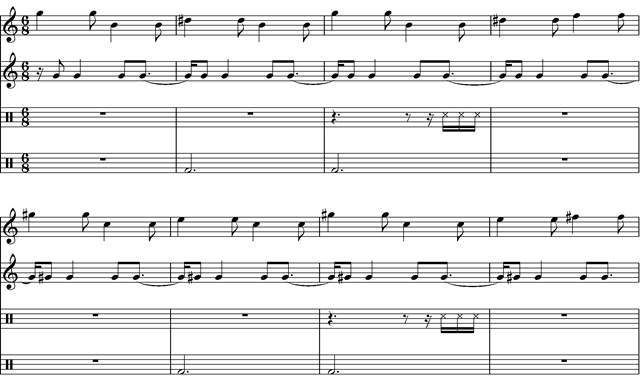
This object is rather simple in terms of construction, but trying to transcribe the exact rhythmic relationship between the two pulse wave tracks was a little more challenging than I had expected.

There are two dissonances at work in this object.  Rhythmically, the melody and pedal tone are just a fraction off in terms of alignment.  On top of that, our percussion tracks give us little structural definition, keeping measures 1 and 4 of each phrase silent, and having no rhythmic resolution to the riff in the third measure. 

The second dissonance is in the harmony itself.  Each four bar phrase outlines an augmented triad, and the phrases are a semitone apart.  It is also interesting that rhythmic dissonance of the two pitched lines create a stark dissonance at the moment when the harmony changes from G+ to G#+.  The G natural rubs up against the G# creating an even more striking dissonance.

Monday, December 12, 2011

Subtle, but AWESOME!!!

Been busy playing The Legend of Zelda: Skyward Sword recently and I noticed something that is really cool about the music component of this game.  When you play the harp, it actually plays harmonies that fit with the environmental object music.  It changes with the harmonies as well. 

So for anyone interested in doing a transcription of environmental objects, you can do a quick recording while Link is playing the harp to get a clear harmonic picture of the object.  I can’t wait to use this in my analysis of the game’s music… when I get around to it (only a dozen Zelda games to get through before I can start to think about this one).

Let me say I also appreciate that when Link plucks the harp during the specific harp moments in the game, the animation is sensitive to the rhythm and pitch of the object.

Sunday, November 20, 2011

The Legend of Zelda: Skyward Sword - The Ballad of the Goddess

In honor of the release of The Legend of Zelda: Skyward Sword today, I bring you an analysis of this theme. What is known now as the Ballad of the Goddess is the first harp song learned in the game, and also the theme that has been used for all promotional material leading up to this release. It is a beautiful piece, and harmonically very interesting.

(Update: 11/9/13 - had to find new youtube videos, so the notation may not match with the music, but the harmonic profile and melody are still the same.)

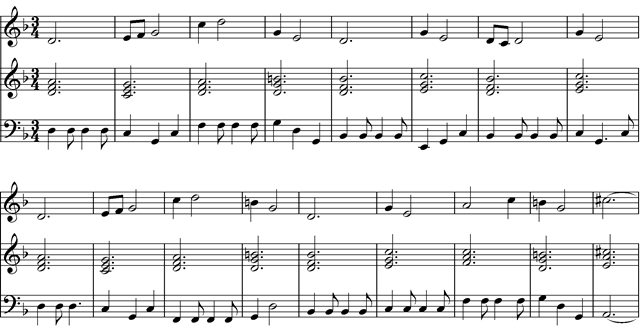
Here is a quick melody and bass line with a harmonic reduction I wrote out.  I’m 99% sure I got it right.
image
For those who have been reading up on Skyward Sword, you might have already heard that this melody is a mirror of Zelda’s Lullaby.  But I want you to see clearly that it is not just a pitch mirror, but a rhythmic mirror as well:
image

Pretty cool!
But really, the more interesting element of this object is the harmony.
There is an element of this object that really plays into a term that I am going to start using and developing as I continue my analysis, called the ZELDA SOUND.
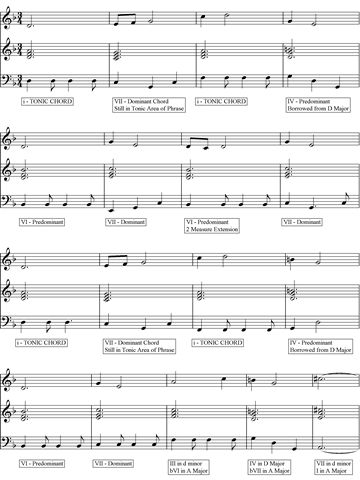
The Zelda Sound started with the first game for the series and continues to this day and is evident in this object.  The Zelda sound is a particular way that the game’s composers have used mode to create harmonic variety in the music.  First look at a roman numeral analysis of the Ballad of the Goddess (don’t worry, I break it down below):
D: i VII i IV VI VII VI VII i VII i IV VI VII III IV V
So the piece is centered around D as a tonic.  Can we call it D Major or D Minor?  That is hard to say.  Which chords in this analysis are minor?  Just the tonic chords?  The composer has borrowed from D major to have a predominantly major sonority with a minor tonic chord. 
Many of the objects in the Zelda series will liberally borrow pitches from parallel modes to create a sound that is distinctly Zelda.  Also there is a trend to use non-typical chords to fulfill a common function.  So, measure by measure, here is how I analyze this object:
image
For those who have been following by blog, you might notice how I hear the end of the object.  I see this object as transitioning from d minor to A major, and the A is emphasized by the “Mario Cadence.”  If you have no idea what I’m talking about, click hear to read my article on the “Mario Cadence.”
After 25 years, there is a whole lot to talk about with this music.

Map Music: SMB3 – World 5

I love looking at the map music objects.  Because of their brevity, you can really dive deep into each object in a very short amount of time.

image
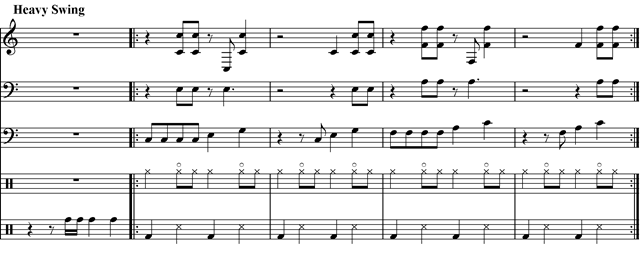
Notice that with this object, our second pulse wave track is significantly lower in pitch, requiring the use of a bass clef for notation.
The big question here is what key are we in????  Looking strictly at this object it is actually unclear.  In a later post, perhaps I will begin to examine some of the objects surrounding this one and looking at overall style to make a deduction, but right now we can either operate in the key of F (alternating V-I progression) or the key of C (a I-IV motion).
What I really love about this object is the heavy swing feel and the bass line, which steals the “melodic” element of the object.  Notice also that there is not a strong pulse on beat 1 of any of the top two lines and the bass only gets it on measures 1 and 3.  The harmonic motion between the two chords creates an overall pulse with significant downbeats on measures 1 and 3.
This is also the only object so far to have an introduction riff.  Why do you suppose the riff was included?  Well there are two possible explanations and I will leave it to you to determine which one or if both have any plausibility:
1) The introductory riff is included to give us a sense of pulse.  Since there are very few emphasis on the strong beats of measures, this riff allows us to feel this rhythmic dissonance by informing us as to the location of the meter.
2) This introduction draws our attention to the C major harmony as tonic with the non-pitch rhythmic introduction serving as a surrogate rhythmic dominant resolving to the tonic.  We can think of it as the end of a drum fill that resolves to the first measure of a new phrase, which is where tonic typically lies.
Now there is a thought… rhythms resolving… maybe there is somewhere I can go with that!

Thursday, November 17, 2011

Map Music: SMB3 – World 4

Eight measure, short and sweet.  The object is harmonically simple as well, a textbook I, ii, V, I progression. (The melody does have some interesting use of non-harmonic tones…)

image

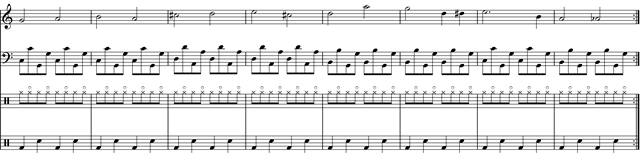
This is a great object however to talk about the rhythmic or metric complexity.  This simple eight measure object contains many layers of rhythmic activity that really can be quite interesting to examine.

Going smallest to largest, we will start with our eighth note layer. This is the shortest note value in the object and one which many ears are drawn to on first listen.  It is emphasized by the alternating octaves in the base and the rhythm of the white noise line:

image

The quarter note layer can also be heard in the bass line, considering each octave interval as one unit, but is also emphasized in the drum set (bass drum and snare):

image

One layer up, is the half note layer.  This relaxed feel is most obvious in the melodic line, but is also reinforced by the drum set line (considering the bass/snare as one larger unit):

image

The whole note layer is felt in the measures.  There is a larger sense of pulse at the unit of the measure created mainly by the time signature of the piece.

A double whole note, or two measure feel, can be felt in the harmonic rhythm  The harmonies change every two measures.  This remains true for the entire object if you consider the Cadential 6/4 and the Dominate chord on the last two measures as one harmonic function.

Lastly, there is a larger four measure pulse as the object is felt with a strong arrival on m. 1 beat 1 as well as m. 5 beat 1 (with the rather dissonance C# leading back up to the D).

One simple eight measure object includes rhythmic/pulse layers all the way from the eighth note to the larger four measure feel.  With everything in between included.  Remarkable!