Tuesday, November 15, 2011

Adventures of Link Analysis: Town Music

image

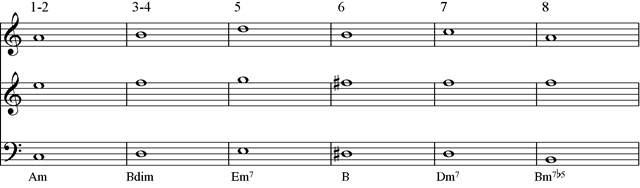
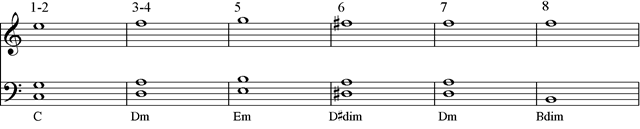
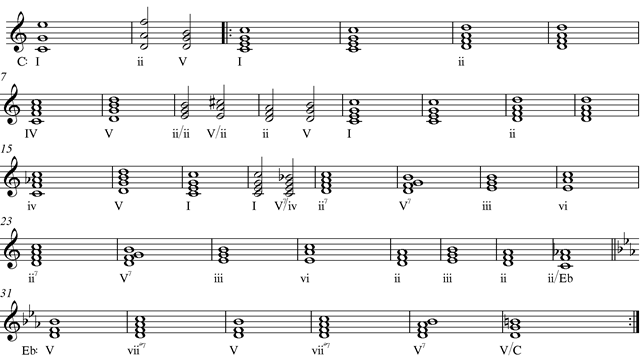
This object is relatively straight forward.  There is occasional modal mixture with the infrequent use of the F minor chord. 

The brief trip to Eb at the end of the object is perhaps the most interesting segment.  I am a little disappointed that the only chords we get in this key are dominant chords and we never get a firm Eb.  I would argue against a key change here, but the key relationships between C and Eb are interesting for us Riemannians (it is a stacked transformation: parallel then relative).

The most interesting harmonic shift is between the last two chords of the object.  A V7 in Eb moving to a V in C.  This is an amazing voice leading phenomenon that seems to parallel the key relationships between these two. Since we are going from the V in the key of Eb, to the V in the key of C, we have to perform the transformation in reverse (relative then parallel):

So our base triad the first chord it [Bb, D, F]

R[Bb, D, F] = [G, Bb, D]
In a relative transformation, the chord is transformed into its relative key.  So in the case of Bb Major, it is transformed into G minor.  This is done by having the top note moved up one step. If the chord were a minor chord and being transformed by a relative transformation, the bottom note would move down one step.

P[G, Bb, D] = [G, B, D]
A parallel transformation takes a chord and transforms it to its parallel major/minor by moving the third a semi-tone in the appropriate direction.

Now, the seventh of the chord, A, does what it naturally wants to do, drops to the G.  That release of tension combined combined with the smooth voice-leading in the rest of the chord makes this key transition smooth as butter.

Saturday, November 5, 2011

Map Music: SMB3 – World 3

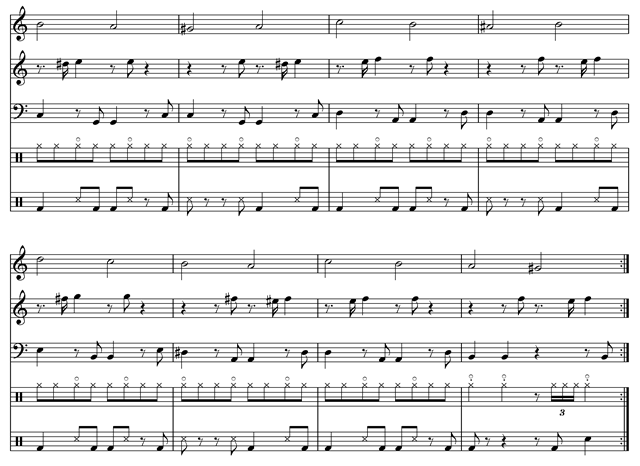
Slightly longer object than the World 2 map, World 3 (water theme) contains eight measures with a cut-time feel:

image

This one perplexes me a bit.  Each of the three pitched lines seems to focus in on a different pitch.  The bass line reduced works out as follows:

image

A simple pattern around a tonic C, emphasized by a chromatic descending line and typical 7-2-1 motion at the cadence.

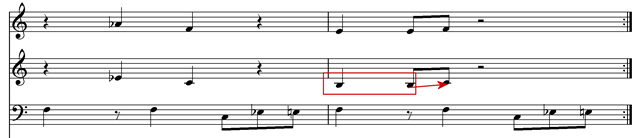
The upper voice tells a different story, seeming to favor centering around A (quasi-schenkerian reduction):

image

Notice how the primary pitches shift rhythmic focus in the second half of the object.

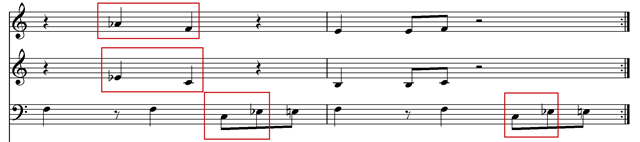
Lastly, the middle tonal line uses chromatic grace notes to emphasize a line similar to the bass line, but around E as the tonal center:

image i

If you put these three reductions together, it makes:

image

Which makes NO SENSE!!!!!!

Ok… so if you take in a bit more information, ignore the top line and just look at the base line and the ornamented second line, you are left with something that you can hold onto harmonically:

image

So aside from measure 8, all we have is a slow decent upwards, and a return downwards… like the ebb and flow of the tide (wink wink).  Measure 8 establishes our tonic by using the leading tone triad to lead us back to C. 

So what about that melody line?  Over this interpretation, it is emphasizing the sixth over the bass in the first four measures, and then adds a seventh onto three of the chords in the last four measures (turning the chord in measure 6 into a dominant-seventh).

We could make a case for bi-modal, some quasi-Bartokean method, or bring in some other theoretical excuse for the melody line, but it works.  It does not feel dissonant, but it does make the whole object very interesting, and one of the reasons we typically do not get tired of hearing this map object when playing the game.

One last note about this object.  Remember, this is the map music for the Water Themed land.  Listen to the water music from the original Super Mario Bros.  Do you hear any similarities to this object? The chromatic lower-neighbor that characterizes this object’s melody is also very prevalent in the original SMB Water Theme.  Coincidence?  Doubtful.

You would almost think that the same guy wrote both of these objects… oh wait…

Thursday, November 3, 2011

Map Music: SMB3 – World 2

Two measures… that is all there is to this object.  But there is a lot of interesting information in these two measures!

First off, what key are we in?  Are we in a key?  Does it matter?!?!?!

Of course it matters!

Our ear is drawn to F as our tonic or central pitch.  Notice the bass line repeating the F and leading into it with a chromatic ascent.  Also the top voice always brings us back to F, first with the descending third, then with the semitone ascent.

image

Now that we have established F as our center, we have to deal with the tonality.  The first measure can be identified as minor, with the E natural used as the leading tone back up to F to solidify our root.

You can see the mirror used between the top line and the bass line, a decent of a minor third followed by an ascent. Provides a nice contour for the object.

image

What about the second measure?  It contains a B natural, not native to any mode of F.  There are two ways you can look at it.  Locally, this B natural serves as the leading tone back up to the fifth of the key.  But taking the whole sonic picture out of context, where else do we hear such a sound?  Blues!  The F blues scale contains both Bb and B.

image

It is also worth noting that, by respelling the accidentals in this object, the minor thirds become augmented seconds, a sound we attribute to the harmonic minor scale.  This sound is always associated with the exotic.  While I’m not going to posit a semiological argument here, the fact that this map is a world of desert sands and pyramids could be the reason these intervals were included.

Multiple levels of modal mixture, intervals interpreted multiple ways, semiology, a firmly established tonic… and I did not even touch on the rhythm.

Two measures… who would have thought could be so interesting!

Wednesday, October 12, 2011

Map Music: SMB3 – World 1

Super Mario Bros. 3 introduced the world map to us, an concept which was used again in Super Mario World and similar games, and has recently come back to us in New Super Mario Bros.

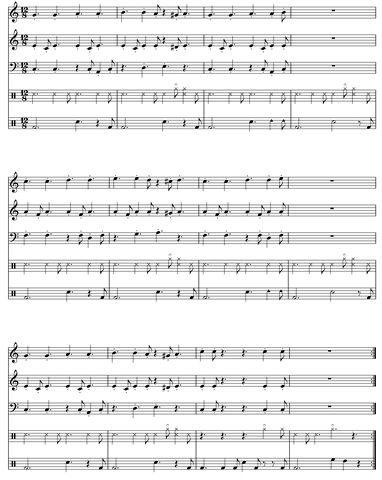
The World 1 map is probably the most recognizable of all the world map objects.  This one is just twelve measures (depending on how you transcribe it).

I chose to write the tune in 12/8 time, however, it could be transcribed in 4/4 with an indication to swing the rhythm. 

image

Super Mario Bros. 3 made use of the mysterious fifth sound channel.  This channel is a PCM channel (pulse-code modulation) which was able to take sampled analog signals and convert them into a digital sound.  SMB3 used this channel to incorporate a more realistic sounding drum set, complete with bass, snare, and toms.  The white noise channel is still used in the same manner as before, to provide a rhythmic backdrop.

There is a conflict between the two rhythmic lines.  The white noise line (line four) is setting up a nice four pattern that seems to compliment the rhythm of the three pitched lines.  However, the PCM Channel (transcribed on line five) seems to be setting up a large feel and more accurately emphasizes when the melody changes pitches. 

So how do you hear the piece?  Does it have an overarching two beat feel, or do you hear a lively four pattern?

And why twelve bars and not a full sixteen?  That would make a much better period.

Harmonically, it is also interesting that they are able to emphasize C as the root of the object, yet there is no emphasis on a dominant harmony.  The first and last phrases are centered on C and the middle phrase is centered on F.  Someone might even mistake this object as an F centric tune, but our ears tell us that C is the root pitch (the B Natural gives it away).

Lastly, notice that the bass line chooses to touch on the relative minor of the respective harmonies emphasized.  That would be a perfect place to drop down to the dominant, but the composer choose to stop short at the submediant.  It gives the object a nice color and does not seem so repetitive.  It really sounds like it could and should go on forever… and it will if you do pick a level.

Saturday, October 8, 2011

8-Bit Zelda Title Themes: A Comparative Analysis

This post was originally intended to be an analytical look at the Title music from The Legend of Zelda: The Adventures of Link, but in doing the analysis, there is just too much to discuss when looking at these two objects together.  As a refresher, here is the Title Music from The Legend of Zelda:

… and the title music from The Legend of Zelda: The Adventures of Link:

The LoZ title music is structured in the following format:

4 measure intro | 6 measure bridge | 8 measure Phrase A | 12 measure Phrase B

In contrast, the LoZ:AL title music breaks down as follows:

4 measure lead in | 8 measure intro | 4 measure bridge | 8 measure Phrase A | 8 measure Phase B

There are some similarities here.  Each object contains two primary phrases of music, with an introduction and a bridge from the intro into the main melodic statement.  On first listen, these two objects appear to have very little in common…

… however…

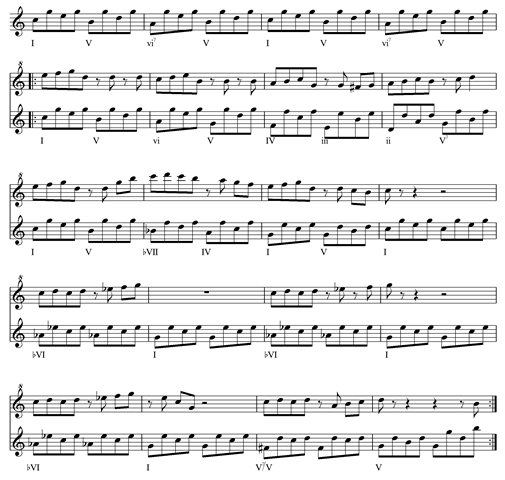
If you look at the harmonies implied in the introduction phrases, you get the following (harmonic rhythm is one chord per measure):

LOZ – Bb | Ab | Gb | F
LOZ:AL – G | F | Eb | D | G | F | Eb | D

Roman Numerals: I – bVII – bVI – V (– I – bVII – bVI – V)

Each of these objects is built on this descending sequence of chords through a modally mixed scale.

Each object uses this progression differently.  In LOZ, the pattern is used again at the beginnings of both Phrase A and B, but then moves to different related harmonies. 

LOZ:AL is entirely based on this progression.  Phrase A emphasizes I, using bVII as a dominant functioning chord, and Phrase B alternates between bVI and V. 

These harmonies are ingrained in the harmonic language of music written by or inspired by Koji Kondo.  I could reference other examples here, but I’ll save it for another day.

Now listen to the two objects again.  Can you here the remarkable similarities?

Monday, September 5, 2011

Super Mario Bros. 2 Analysis – Ending (Part 2)

Six months later and we finally get the epic conclusion of this analytical mini-series.

Well, I’m not sure how epic a conclusion it is, but we will make the best of it!

SMB2 Ending

This is a pretty straight forward excerpt.  There is a nice passing motion between the V and IV chord on the third line represented by a bVII, though functioning only as a passing motion.  Also, there is a nice sequence descending from V to ii early on in the excerpt.

What I want to draw your attention to here is the last eight measures.  Why do you ask?  Well the progression alternating from bVI to I ending in a secondary dominant half cadence is not new.  It may not sound familiar, but with a little bit of chord analysis, you will soon see:

image

This is the third formal section of the original Super Mario Bros. theme.  The exact same chord progression in the exact same key, with the same harmonic rhythm.

Intentional?  Maybe.  Pretty Cool? Absolutely.

Sunday, September 4, 2011

Review: Reale’s “Chaos in the Cosmos”

The first article I want to take a look at was recently published in a new journal based out of Germany.  This music journal ACT focuses on the relationship between music and performance.  Steven B. Reale published an article entitled “Chaos in the Cosmos: The Play of Contradictions in the Music of Katamari Damacy.”

This article was very interesting to me.  First off, the game examined is not one I would consider first for an analysis, mainly because the qwerty, cutesy nature of the games initial appearance.  However, fans of the game will be very familiar with all the contradictions in the game, from the King’s attitude towards his son and his subjects vs. the generally happiness that seems to pervade every angle of the game.

The article begins with an overview of the game’s plot and examination of some of the contradictions that occur in the story and dialogue of the game.  He also uses this point to examine the kawaii culture of the Japanese and how that plays into the game design.

The rest of the article focuses on examining the various music elements of the game.  He traces the use of a particular tune throughout many of the different music objects in the game, and also examines the reinterpretation of certain tunes.  He comments on the juxtaposition of acoustic and digital music throughout and gives us a great overview of the music throughout this game through an analytical lens.

The resulting conclusion of the analysis looks to paint a picture of the games contradictions as it is embodied in the music, from the terrible vs. kawaii, digital vs. acoustic, and overall right vs. wrong.  Steven’s article takes us much deeper into a game that on the surface does not seem to offer as much as is actually there.