Thursday, July 31, 2014

Game Score Forms: Linear

For those who have been following my articles, you know that most of the groundwork for my posts originated on my graduate thesis Examining Non-Linear Forms: Techniques for the Analysis of Scores Used in Video Games.  I want to explore an under-developed topic from that work, and that is the concept of form within a video game score.

My primary interest in game music analysis is “big picture” analysis: how do you examine the entire game music score and all its objects to make sense of it, and how does it help to inform other aspects of ludology.  I utilize game score graphs to visualize all the objects in a game or section of a game, and help to inform analysis of relationships and the score as a whole.

In doing these graphs, there are a couple of “forms” that begin to emerge.  These forms mirror the format of the games themselves, though sometimes these forms are not as obvious as the game design itself.  The first is Linear.  Before I dive to far in, I want to say that game scores are rarely just one type or the other, but usually some sort of combination of different styles. 

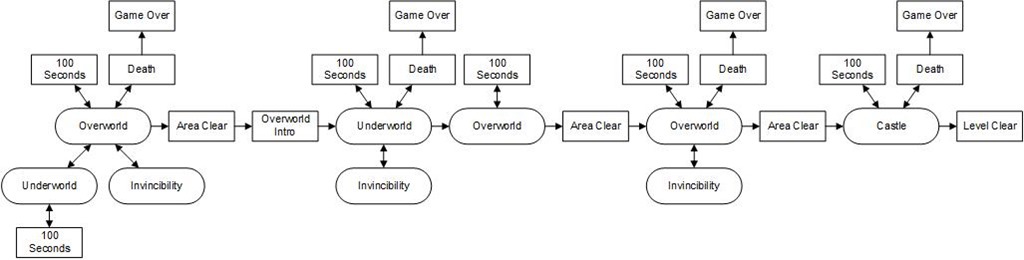
In a Linear game score form, the player is forced to experience the game music objects in a set order.  When the game score has a strong linear component, the composer has a much larger control over the musical direction of the objects and game itself.  One of the clearest, simplest example to look at is the original Super Mario Bros.  We will examine the entire Real Time Game Score Graph (RTGSG) of World 1 as we explore the linear form:
Super Mario Bros - World 1

(Click to zoom.)

For those who have not seen these graphs before, rounded objects are objects that loop, while squared objects are of a definite length.  Using Schenkerian terms, this is a very surface level look at the game score graph, as we are displaying each and every object.

When looking at an RTGSG, you can identify linear structures as structures that continue to move forward through various objects.  There is no central object that stands out as being the single return point.  One might argue that the “Overworld” object in this game is one such object, but if you look at the place and function of it, it holds the same weight per instance as the Underworld or Castle object as the predominant object for a section of the game.  The structure of the game, and therefore these objects, put us on a continuous fixed path throughout the game that gives this RTGSG a predominantly linear structure.

It will be more obvious if we reduce this RTGSG down to a more middle ground texture.  Borrowing concepts and techniques from Schenker, many of these objects can be reduced out of the surface level to give us a deeper structure of this game score:

Super Mario Bros - World 1 Middle Ground

Just as you would reduce out embellishment tones in a middle-ground schenker graph, these objects that interject within other objects can be reduced out as well.  Now the linear texture is much more obvious.

When looking to analyze larger sections of game scores, one technique is to identify what type of form the game score has.  That will inform the best way to approach a large scale analysis.  Now that we have gotten a core linear structure of Super Mario Bros: World 1, we can examine each individual object and its tonal center.

Much of the anaylsis of the individual objects is found in my thesis, so I will just summerize the tonal centers:

Overworld – C
Area Clear – C
Underworld – C
Castle – Minor/Dissonant but loosely G Centric
Level Clear – C (Ending on V)

So if you lay out the tonal centers in the linear order of the object, you can see the overall tonal progression from start to finish:

C – C – C – C – C – C – C – C – G – C

While this example is very simplistic, it is interesting to see how every object supports the C tonal center from start to finish until you get to the penultimate object, the castle.  The game score moves us to a tonal center on the dominant, which fights for the resolution, just as this level is one of the more challenging of the World, and the most tense.  The music reinforces the game play and inform the emotions of the player, so that when the level is completed and the Level Clear object plays, we finally get a resolution to C.

However, as we can see, the object that resolves ends in a half cadence, musically carrying us to the next World and its progression.  As you can image, this will continue until the game is won and the final Victory object is played, which ends in the most textbook perfect authentic cadence (melody going from re to do, and the bass from V – I).

I will discuss other types of game score forms in futures posts.  For now, I hope that this quick overview will help you start to conceptualize the entire game score as an object and give you tools to start working through larger pieces.
Wednesday, July 4, 2012

SMB3 Music: Pre-Post Ship Music

So I’ve been having some difficulties with embedding audio in my posts.  I think I finally have something that works, and I’ll be looking into updating my older posts to get the audio running smoothly.

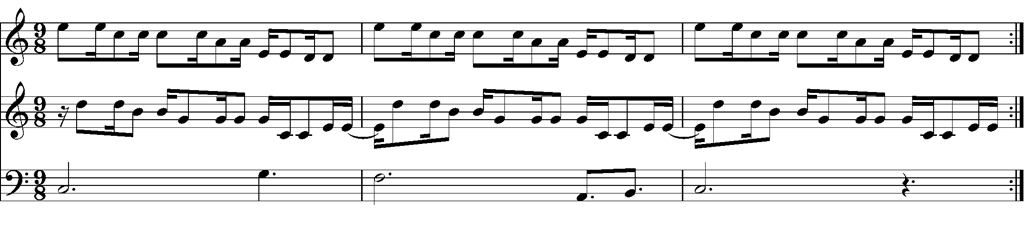
Now on with the game!  Today’s music object is a short little ditty, played before entering one of the battle ship levels in SMB3, and is also played after the boss is defeated during the fall back to earth.

image

Each measure of this object contains the exact same music for the upper two pulse wave tracks.  The lower triangle wave bass line is a seemingly logical harmonic progression with very strong voice leading tendencies, which seem to outline a I – IV – V – I progression.

Notice now that the upper voices contain the pitches [A, C, E, G, B, D].  Sure, it is a C major scale without the leading tone.  I find the arrangement of the tones in the measure interesting.  They seem to evoke two harmonies at the same time.  The staggering of the rhythm allow our ears to pick out one set or another, and the changing notes in the bass allow our ears to float between the different the different harmonies outlined in the upper two voices.

I am moving towards a larger picture here with the SMB3 objects, but I have a few more objects to examine before I can look at that big picture.

Tuesday, April 24, 2012

SMB3 Music: You’ve Found the Princess

image

NB: All my analysis of SMB3 is from the NES version of the game, not the SNES Mario All-Stars remake.  There are very significant differences between the two, which may be the subject of future posts.

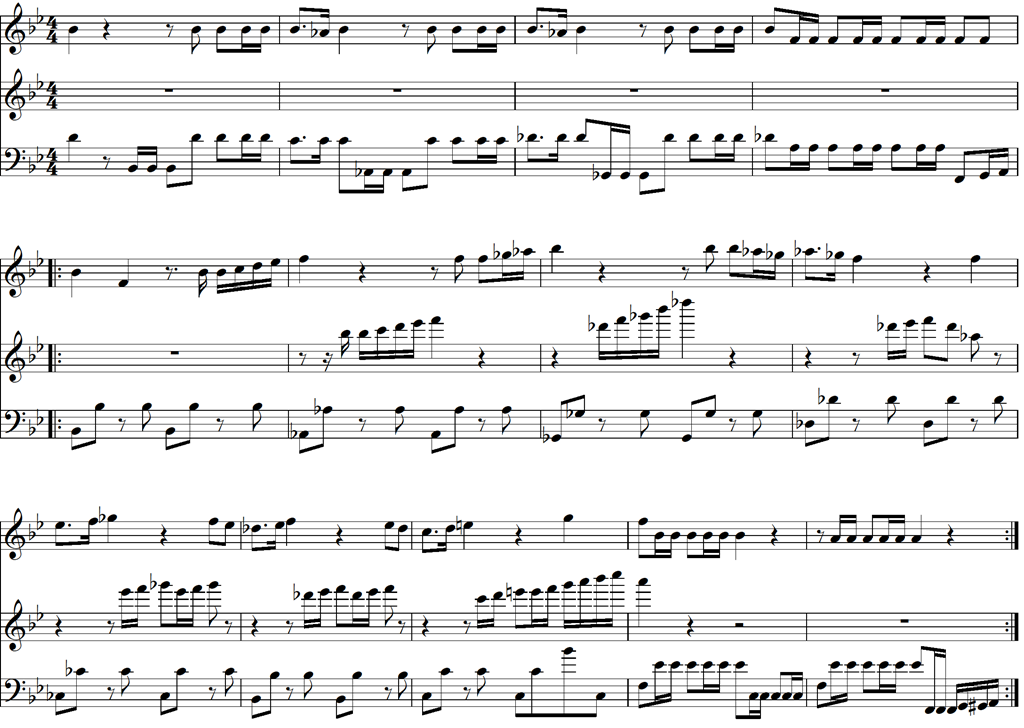
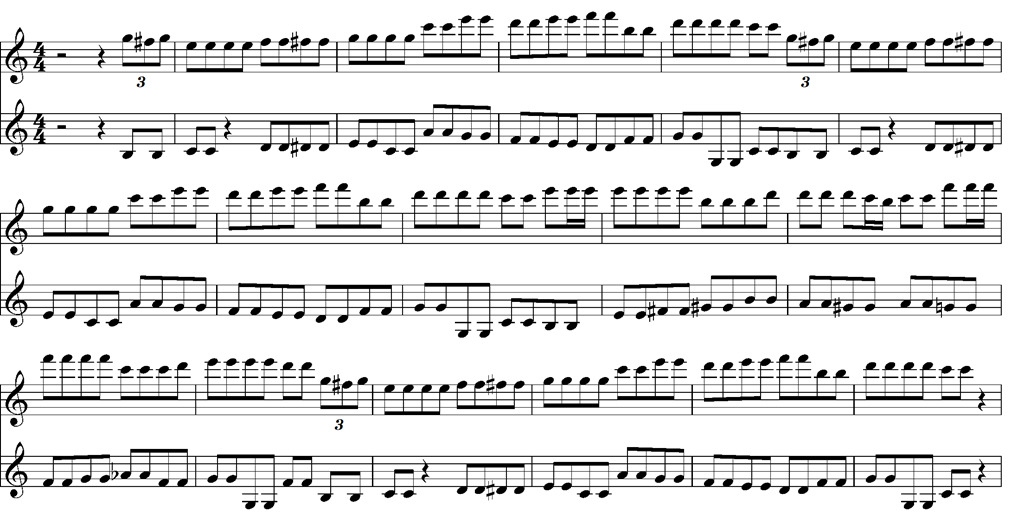
Now this object has a lot of notes in it but it is designed to give an echo effect.  If you take away the composed echo, the object looks more like:

image

This is a non-looping object that goes right into the credit music when it is over.

Those who are familiar with the early Mario series will recognize the first phrase of this tune.  This was the “You’ve Found the Princess” object from the original SMB.  It was originally scored in three parts with a solid bass line, and looped the four bars over and over again.  This object is much more developed, removing the bass line for a very simple rendition, almost anti-climatic to the ending of the game after facing so many challenges. 
Harmonically the opening is rather predictable: I – ii – V – I.

The object gets interesting after the opening phrases.

image

The E:iv in the second measure of this example is very interesting in that it can also be heard as a bII of E or even a I6 in F.  The removal of the bass line allowed for some amazing compositional flexibility, tricking our ears in to hearing different harmonies, all the while the music is really an amazing display of counterpoint:

image

The “mode” of the counterpoint changes on the interval of an octave or sixth, preceded by either a leap of a fourth/fifth or a stepwise motion.  While that statement described pretty much the entire history of tonal music, it is fascinating to see this at work here, in a video game object, at with such interesting key relationships.

The object’s key is C Major, with two bars in E major and two bars in F minor.  I – III – iv – I.

The I moves to III via a LP transformation (for you neo-Riemannians).  This transformation actually happens in the music. Though it is disguised as an anticipation, this is the moment of transformation:

image

III moves to iv via a sequence.  A typical modulation via a pivot chord and secondary dominant “brings us back to do” as they say.

Take a listen to the object now and see what you think:

Thursday, March 22, 2012

Map Music: SMB3–Warp Map


image

This is a cute little object that appears if you are lucky enough to find one of the warp whistles hidden in the early levels of the game.  Upon activating the whistle, you hear the first measure of this object, a little melody that seems have a b minor feel, (though there are a couple other ideas around that).  Then you are transported to the warp map, where these four measures are repeated over and over until you select the world you want to warp too.

One interesting melodic tidbit to pay attention to is the turn around at the loop.  Notice the chromatic decent from Bb to G.  This is the same melodic profile of the flute melody (D chromatic down to B, four descending semitones). It is a nice musical relation between these objects which are obviously related in game play.

Its nice a simple, alternating between C and Db Major chords, with C as the obvious central harmony.  This is due mainly because at the loop repeat the melody descends chromatically to, emphasizing the prevalence of that harmony (C major).

Fans of a bit of reduction or prolongational theory might be interested to see that this is just one big C major chord that happens to be embellished by a chromatic upper neighbor:

image

Saturday, March 10, 2012

8-Bit Zelda Title Themes: A Comparative Analysis Continued…

By request, I’m going to take a look at the comparison of The Legend of Zelda (NES) and The Legend of Zelda: Links Awakening (NGB).

The Comment was on my previous post: I'd be more interested in hearing your analysis between this and the theme music for The Legend of Zelda: Link's Awakening. After the cinematic portion, it's the same tune, but it's played differently.

I love this comment, because this is EXACTLY how I got into doing this research.  One of my many theoretical interests is the analysis of similar objects within a series of games (see my article on the analysis of Overworld objects in Zelda).

But I digress… lets look at the differences between these two objects.  Below is a transcription of the title screen object from The Legend of Zelda: Link’s Awakening.

image

These two objects are very similar.

To recap from my previous posts, the LoZ title music is structured in the following format:

4 measure intro | 6 measure bridge | 8 measure Phrase A | 12 measure Phrase B

In contrast, the LoZ:LA title music breaks down as follows:

4 measure intro | 8 measure Phrase A + 1 measure extension

It is significantly more compact that the original theme.  Harmonically, the tunes are exactly the same.  Melodically, the biggest difference is the use of dotted-eight/sixteenth rhythms instead of the familiar triplet pattern.

LoZ:LA lacks a percussion track that was present in the original.  It also uses the bass line as two voices, often jumping between registers to provide harmony for the lead track and then a harmonic foundation.

There are little obbligato sections in the middle line that add a different flourish to the tune. The alternating octaves and bouncy eighth-note rhythm of the bass line add a much lighter tone to the object as a whole than the original, which was much more driving and serious.

Some of these differences could be due to space and or sound limitations on the game boy.  I find is so interesting that this object completely lacks the triplet figure so associated with many of Zelda’s musical themes across the all the games.

I’m also a very big fan of this one measure extension that was written into the LoZ:LA object.  There is no real good reason why they could not have just had the final measure be exactly like it was in the original.  Yet, they decided to change the harmony slightly and add a one measure extension to throw us off.  The best explanation I can come up for why they chose to do this was to make us think that something different was about to happen.  It helps put a period on the object in such a way as to mark the repeat.  We are so used to this melody continuing on to a second and longer phrase, but this time it does not, and the change at the end of the phrase defines that point.

So really the biggest difference between these objects is style.  Yes the melody is almost the same, the harmonies are exactly the same, yet there are some very interesting differences.  Listen two these two objects back to back, specifically listening for the style differences in the way the bass lines are different, as well as the lack of triplet rhythms.

Thursday, March 8, 2012

Map Music: SMB3 – World 8

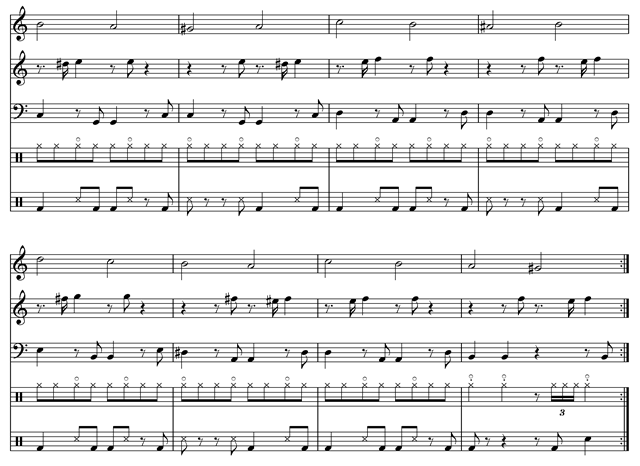
image

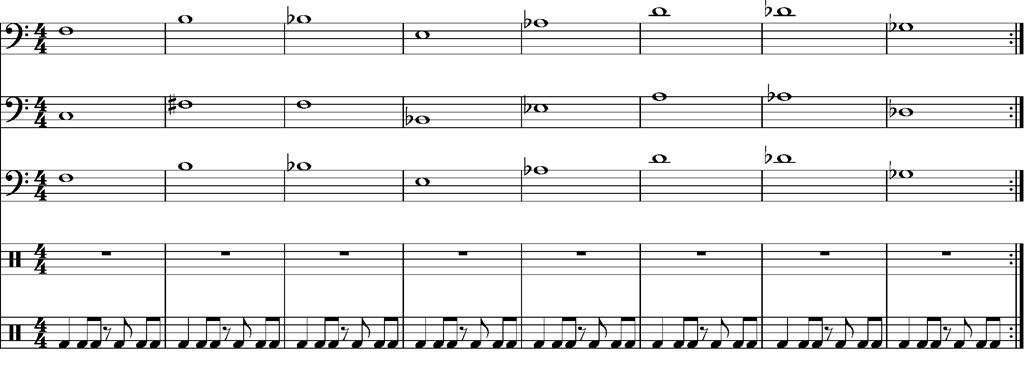
So just three lines here.  The Triangle Wave and one Pulse wave track are identical in pitch and register (slightly different timbre). 

I am mostly interested in intervals with this object.  The object can be heard as centered around F.  The half step decent at the repeat from Gb to F draws us back to F as our tonic pitch.

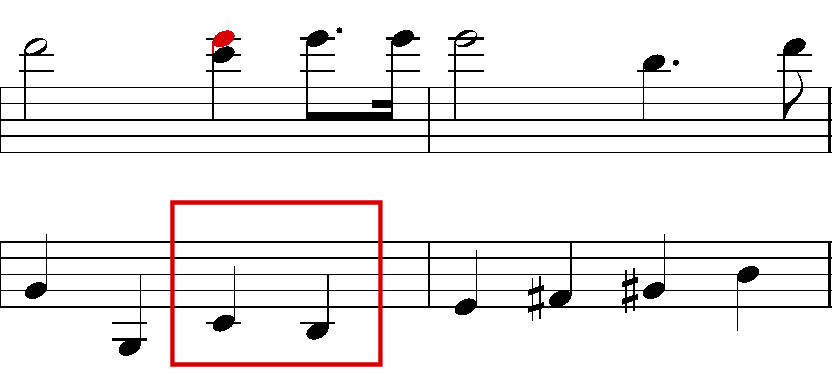
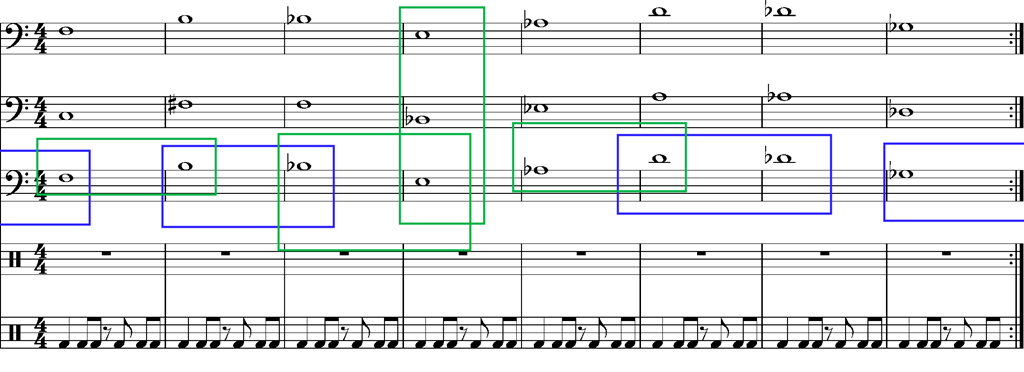
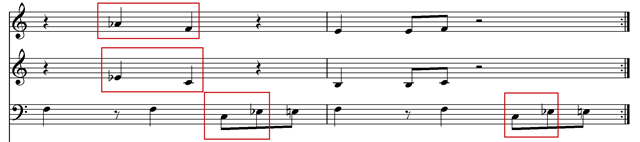
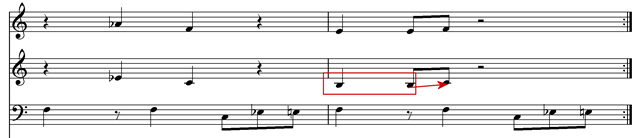
In the score below, I have boxed several intervals.  All the blue boxes are half step motions and the green boxes are tritones.  Notice how all the intervals between the lines (vertically) are P5s except for measure 4, where they chose to use a tritone.

image

So some very interesting patterns here.  Measures 1-3 and Measures 5-7 are transpositions of each other of ic3.  Measure 8 leads back to m1 with a semitone descent.  So how does measure 4 set up measure 5?  Well, there are two prominent harmonies that contain tritones: diminished chords and dominant 7th chords.  If this were a dominant 7th (C7), we would expect the following chord to have something to do with Tonic.  We could hear it as a i7 chord.  However, it most likely has a function akin to a diminished or diminished 7 chord, which is used often to modulate from one section to another since they can resolve in so many different ways. I can easily hear measure 3 as a edim7 to an Ab triad.

So what can be learned from looking at all these map objects together?  Is there something on a higher level that connects these objects together?  That and more coming soon!

Tuesday, March 6, 2012

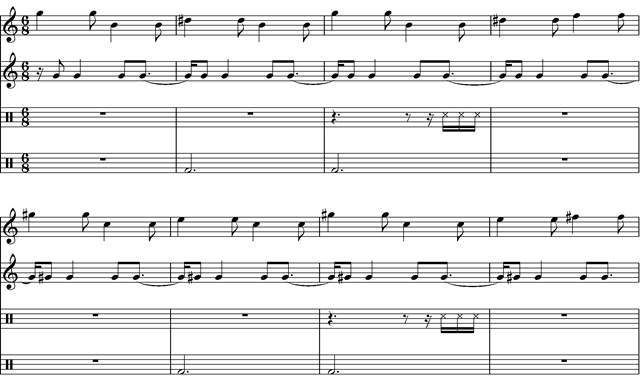
Map Music: SMB3 – World 7

As we continue with our series on Super Mario Bros. 3 Map Music objects, we come to this lovely tune.  Though its written rather straight here, the tune is heavily swung in reality.

image

So this is a great little object.  Makes you feel like you are in a smooth jazz club sipping on a drink, enjoying the combo playing on stage.  At first I looked at this and did not see anything terribly interesting.  The object is a lot of open fifths.  So I set out to look at key and harmony.

By looking at the bass line, you can discern that the object is in the key of F.  C moving up to F is a great fifth motion to imply a dominant-tonic relationship.  The addition of the Eb seems natural for this music as often as we have seen the use of the bVIII functioning as a dominant harmony.  I tried looking at the pitches between the two lines, but there is nothing really to note.  At the core, it’s a feeling of F major with a lot of jazz color thrown in the mix.

So I set about harmonizing the piece with chords of my own.  I’m still playing around with some different options, because the object lends itself to be heard with some different options.

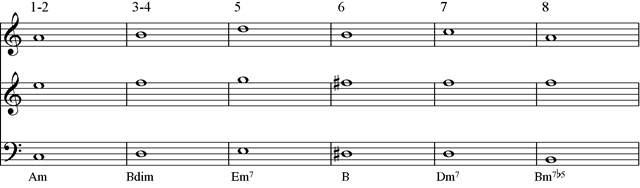
The harmonic rhythm of this melody, as I hear it is:

image

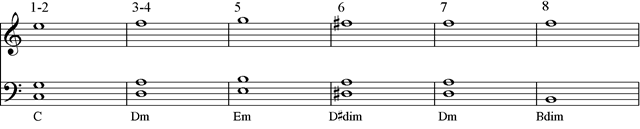
With the bass dropping out in measure two, our hears continue to hear the F ringing underneath the ornamental figure in the upper two voices.  I like to hear this object as rocking back and forth between a dominant and tonic sound.  It’s the dominant sound that I am having difficulty deciding on.  There are three dominant areas and two tonic areas in this object.  Two of the three dominant areas could be heard with either a V, bVII (add6), or v7.  However, the final dominant area is most certainly a v7, so I have extracted that backwards to the other two.  The fact that the object loops over and over again will force the ear to hear it this way as well. Listen to the object with this harmony superimposed upon it.

image

Nice simple back beat to the object, but a rather syncopated harmonic rhythm.

Wednesday, January 18, 2012

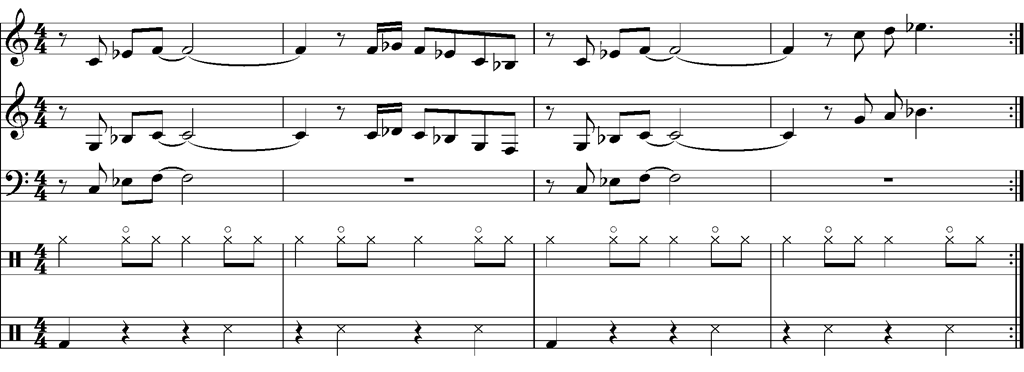
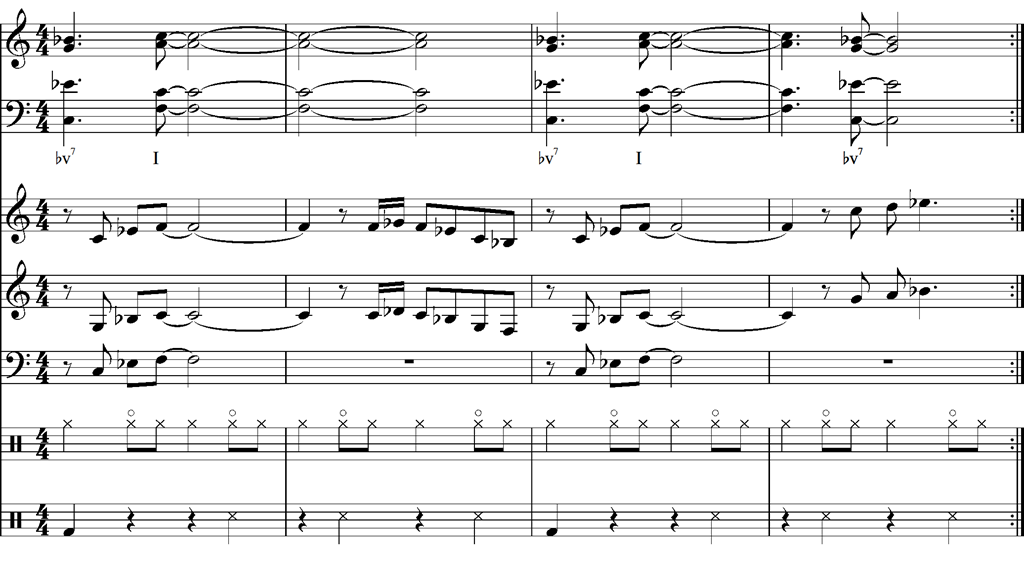
Map Music: SMB3 – World 6

image

This object is rather simple in terms of construction, but trying to transcribe the exact rhythmic relationship between the two pulse wave tracks was a little more challenging than I had expected.

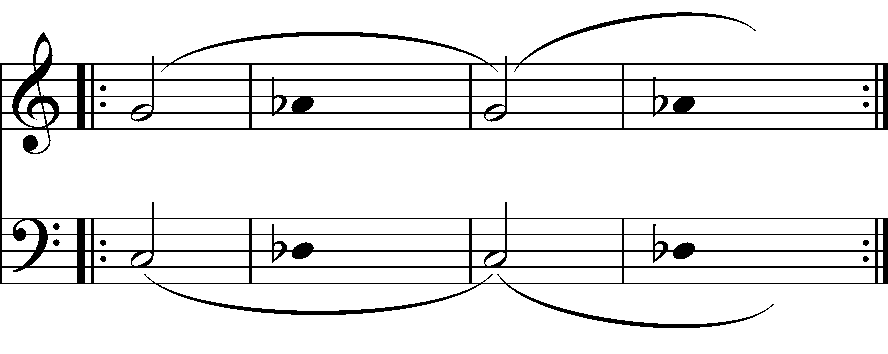
There are two dissonances at work in this object.  Rhythmically, the melody and pedal tone are just a fraction off in terms of alignment.  On top of that, our percussion tracks give us little structural definition, keeping measures 1 and 4 of each phrase silent, and having no rhythmic resolution to the riff in the third measure. 

The second dissonance is in the harmony itself.  Each four bar phrase outlines an augmented triad, and the phrases are a semitone apart.  It is also interesting that rhythmic dissonance of the two pitched lines create a stark dissonance at the moment when the harmony changes from G+ to G#+.  The G natural rubs up against the G# creating an even more striking dissonance.

Monday, December 12, 2011

Subtle, but AWESOME!!!

Been busy playing The Legend of Zelda: Skyward Sword recently and I noticed something that is really cool about the music component of this game.  When you play the harp, it actually plays harmonies that fit with the environmental object music.  It changes with the harmonies as well. 

So for anyone interested in doing a transcription of environmental objects, you can do a quick recording while Link is playing the harp to get a clear harmonic picture of the object.  I can’t wait to use this in my analysis of the game’s music… when I get around to it (only a dozen Zelda games to get through before I can start to think about this one).

Let me say I also appreciate that when Link plucks the harp during the specific harp moments in the game, the animation is sensitive to the rhythm and pitch of the object.

Sunday, November 20, 2011

The Legend of Zelda: Skyward Sword - The Ballad of the Goddess

In honor of the release of The Legend of Zelda: Skyward Sword today, I bring you an analysis of this theme. What is known now as the Ballad of the Goddess is the first harp song learned in the game, and also the theme that has been used for all promotional material leading up to this release. It is a beautiful piece, and harmonically very interesting.

(Update: 11/9/13 - had to find new youtube videos, so the notation may not match with the music, but the harmonic profile and melody are still the same.)

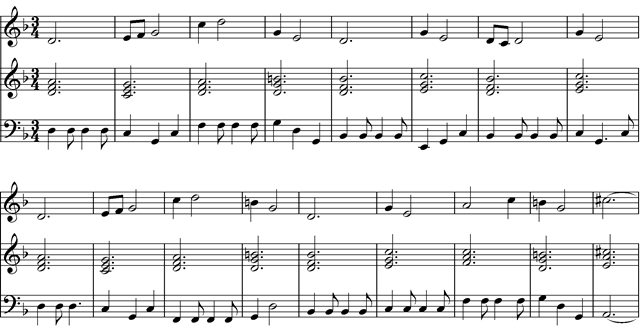
Here is a quick melody and bass line with a harmonic reduction I wrote out.  I’m 99% sure I got it right.
image
For those who have been reading up on Skyward Sword, you might have already heard that this melody is a mirror of Zelda’s Lullaby.  But I want you to see clearly that it is not just a pitch mirror, but a rhythmic mirror as well:
image

Pretty cool!
But really, the more interesting element of this object is the harmony.
There is an element of this object that really plays into a term that I am going to start using and developing as I continue my analysis, called the ZELDA SOUND.
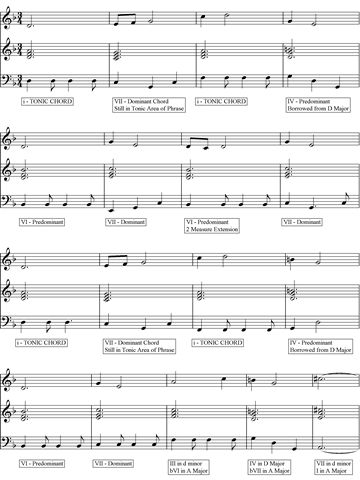
The Zelda Sound started with the first game for the series and continues to this day and is evident in this object.  The Zelda sound is a particular way that the game’s composers have used mode to create harmonic variety in the music.  First look at a roman numeral analysis of the Ballad of the Goddess (don’t worry, I break it down below):
D: i VII i IV VI VII VI VII i VII i IV VI VII III IV V
So the piece is centered around D as a tonic.  Can we call it D Major or D Minor?  That is hard to say.  Which chords in this analysis are minor?  Just the tonic chords?  The composer has borrowed from D major to have a predominantly major sonority with a minor tonic chord. 
Many of the objects in the Zelda series will liberally borrow pitches from parallel modes to create a sound that is distinctly Zelda.  Also there is a trend to use non-typical chords to fulfill a common function.  So, measure by measure, here is how I analyze this object:
image
For those who have been following by blog, you might notice how I hear the end of the object.  I see this object as transitioning from d minor to A major, and the A is emphasized by the “Mario Cadence.”  If you have no idea what I’m talking about, click hear to read my article on the “Mario Cadence.”
After 25 years, there is a whole lot to talk about with this music.

Map Music: SMB3 – World 5

I love looking at the map music objects.  Because of their brevity, you can really dive deep into each object in a very short amount of time.

image
Notice that with this object, our second pulse wave track is significantly lower in pitch, requiring the use of a bass clef for notation.
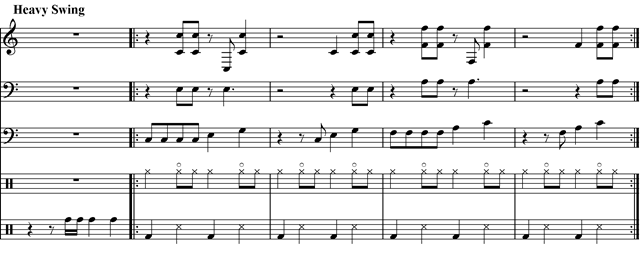
The big question here is what key are we in????  Looking strictly at this object it is actually unclear.  In a later post, perhaps I will begin to examine some of the objects surrounding this one and looking at overall style to make a deduction, but right now we can either operate in the key of F (alternating V-I progression) or the key of C (a I-IV motion).
What I really love about this object is the heavy swing feel and the bass line, which steals the “melodic” element of the object.  Notice also that there is not a strong pulse on beat 1 of any of the top two lines and the bass only gets it on measures 1 and 3.  The harmonic motion between the two chords creates an overall pulse with significant downbeats on measures 1 and 3.
This is also the only object so far to have an introduction riff.  Why do you suppose the riff was included?  Well there are two possible explanations and I will leave it to you to determine which one or if both have any plausibility:
1) The introductory riff is included to give us a sense of pulse.  Since there are very few emphasis on the strong beats of measures, this riff allows us to feel this rhythmic dissonance by informing us as to the location of the meter.
2) This introduction draws our attention to the C major harmony as tonic with the non-pitch rhythmic introduction serving as a surrogate rhythmic dominant resolving to the tonic.  We can think of it as the end of a drum fill that resolves to the first measure of a new phrase, which is where tonic typically lies.
Now there is a thought… rhythms resolving… maybe there is somewhere I can go with that!

Thursday, November 17, 2011

Map Music: SMB3 – World 4

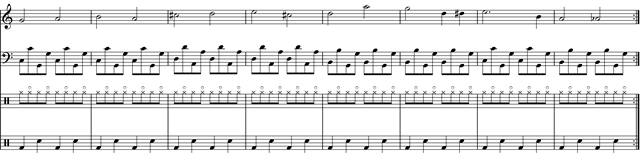
Eight measure, short and sweet.  The object is harmonically simple as well, a textbook I, ii, V, I progression. (The melody does have some interesting use of non-harmonic tones…)

image

This is a great object however to talk about the rhythmic or metric complexity.  This simple eight measure object contains many layers of rhythmic activity that really can be quite interesting to examine.

Going smallest to largest, we will start with our eighth note layer. This is the shortest note value in the object and one which many ears are drawn to on first listen.  It is emphasized by the alternating octaves in the base and the rhythm of the white noise line:

image

The quarter note layer can also be heard in the bass line, considering each octave interval as one unit, but is also emphasized in the drum set (bass drum and snare):

image

One layer up, is the half note layer.  This relaxed feel is most obvious in the melodic line, but is also reinforced by the drum set line (considering the bass/snare as one larger unit):

image

The whole note layer is felt in the measures.  There is a larger sense of pulse at the unit of the measure created mainly by the time signature of the piece.

A double whole note, or two measure feel, can be felt in the harmonic rhythm  The harmonies change every two measures.  This remains true for the entire object if you consider the Cadential 6/4 and the Dominate chord on the last two measures as one harmonic function.

Lastly, there is a larger four measure pulse as the object is felt with a strong arrival on m. 1 beat 1 as well as m. 5 beat 1 (with the rather dissonance C# leading back up to the D).

One simple eight measure object includes rhythmic/pulse layers all the way from the eighth note to the larger four measure feel.  With everything in between included.  Remarkable!

Tuesday, November 15, 2011

Adventures of Link Analysis: Town Music

image

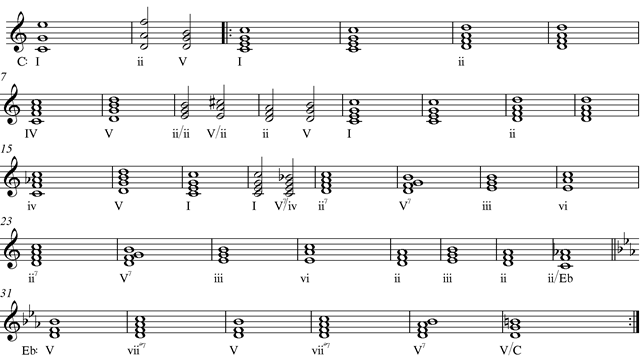
This object is relatively straight forward.  There is occasional modal mixture with the infrequent use of the F minor chord. 

The brief trip to Eb at the end of the object is perhaps the most interesting segment.  I am a little disappointed that the only chords we get in this key are dominant chords and we never get a firm Eb.  I would argue against a key change here, but the key relationships between C and Eb are interesting for us Riemannians (it is a stacked transformation: parallel then relative).

The most interesting harmonic shift is between the last two chords of the object.  A V7 in Eb moving to a V in C.  This is an amazing voice leading phenomenon that seems to parallel the key relationships between these two. Since we are going from the V in the key of Eb, to the V in the key of C, we have to perform the transformation in reverse (relative then parallel):

So our base triad the first chord it [Bb, D, F]

R[Bb, D, F] = [G, Bb, D]
In a relative transformation, the chord is transformed into its relative key.  So in the case of Bb Major, it is transformed into G minor.  This is done by having the top note moved up one step. If the chord were a minor chord and being transformed by a relative transformation, the bottom note would move down one step.

P[G, Bb, D] = [G, B, D]
A parallel transformation takes a chord and transforms it to its parallel major/minor by moving the third a semi-tone in the appropriate direction.

Now, the seventh of the chord, A, does what it naturally wants to do, drops to the G.  That release of tension combined combined with the smooth voice-leading in the rest of the chord makes this key transition smooth as butter.

Saturday, November 5, 2011

Map Music: SMB3 – World 3

Slightly longer object than the World 2 map, World 3 (water theme) contains eight measures with a cut-time feel:

image

This one perplexes me a bit.  Each of the three pitched lines seems to focus in on a different pitch.  The bass line reduced works out as follows:

image

A simple pattern around a tonic C, emphasized by a chromatic descending line and typical 7-2-1 motion at the cadence.

The upper voice tells a different story, seeming to favor centering around A (quasi-schenkerian reduction):

image

Notice how the primary pitches shift rhythmic focus in the second half of the object.

Lastly, the middle tonal line uses chromatic grace notes to emphasize a line similar to the bass line, but around E as the tonal center:

image i

If you put these three reductions together, it makes:

image

Which makes NO SENSE!!!!!!

Ok… so if you take in a bit more information, ignore the top line and just look at the base line and the ornamented second line, you are left with something that you can hold onto harmonically:

image

So aside from measure 8, all we have is a slow decent upwards, and a return downwards… like the ebb and flow of the tide (wink wink).  Measure 8 establishes our tonic by using the leading tone triad to lead us back to C. 

So what about that melody line?  Over this interpretation, it is emphasizing the sixth over the bass in the first four measures, and then adds a seventh onto three of the chords in the last four measures (turning the chord in measure 6 into a dominant-seventh).

We could make a case for bi-modal, some quasi-Bartokean method, or bring in some other theoretical excuse for the melody line, but it works.  It does not feel dissonant, but it does make the whole object very interesting, and one of the reasons we typically do not get tired of hearing this map object when playing the game.

One last note about this object.  Remember, this is the map music for the Water Themed land.  Listen to the water music from the original Super Mario Bros.  Do you hear any similarities to this object? The chromatic lower-neighbor that characterizes this object’s melody is also very prevalent in the original SMB Water Theme.  Coincidence?  Doubtful.

You would almost think that the same guy wrote both of these objects… oh wait…

Thursday, November 3, 2011

Map Music: SMB3 – World 2

Two measures… that is all there is to this object.  But there is a lot of interesting information in these two measures!

First off, what key are we in?  Are we in a key?  Does it matter?!?!?!

Of course it matters!

Our ear is drawn to F as our tonic or central pitch.  Notice the bass line repeating the F and leading into it with a chromatic ascent.  Also the top voice always brings us back to F, first with the descending third, then with the semitone ascent.

image

Now that we have established F as our center, we have to deal with the tonality.  The first measure can be identified as minor, with the E natural used as the leading tone back up to F to solidify our root.

You can see the mirror used between the top line and the bass line, a decent of a minor third followed by an ascent. Provides a nice contour for the object.

image

What about the second measure?  It contains a B natural, not native to any mode of F.  There are two ways you can look at it.  Locally, this B natural serves as the leading tone back up to the fifth of the key.  But taking the whole sonic picture out of context, where else do we hear such a sound?  Blues!  The F blues scale contains both Bb and B.

image

It is also worth noting that, by respelling the accidentals in this object, the minor thirds become augmented seconds, a sound we attribute to the harmonic minor scale.  This sound is always associated with the exotic.  While I’m not going to posit a semiological argument here, the fact that this map is a world of desert sands and pyramids could be the reason these intervals were included.

Multiple levels of modal mixture, intervals interpreted multiple ways, semiology, a firmly established tonic… and I did not even touch on the rhythm.

Two measures… who would have thought could be so interesting!

Wednesday, October 12, 2011

Map Music: SMB3 – World 1

Super Mario Bros. 3 introduced the world map to us, an concept which was used again in Super Mario World and similar games, and has recently come back to us in New Super Mario Bros.

The World 1 map is probably the most recognizable of all the world map objects.  This one is just twelve measures (depending on how you transcribe it).

I chose to write the tune in 12/8 time, however, it could be transcribed in 4/4 with an indication to swing the rhythm. 

image

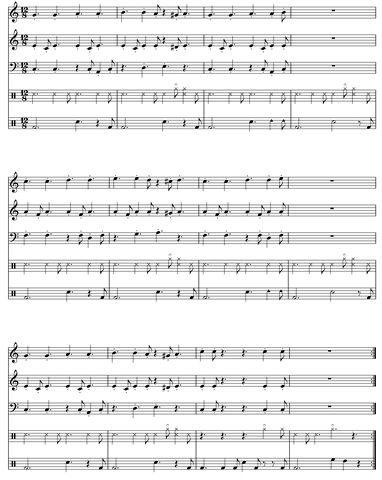
Super Mario Bros. 3 made use of the mysterious fifth sound channel.  This channel is a PCM channel (pulse-code modulation) which was able to take sampled analog signals and convert them into a digital sound.  SMB3 used this channel to incorporate a more realistic sounding drum set, complete with bass, snare, and toms.  The white noise channel is still used in the same manner as before, to provide a rhythmic backdrop.

There is a conflict between the two rhythmic lines.  The white noise line (line four) is setting up a nice four pattern that seems to compliment the rhythm of the three pitched lines.  However, the PCM Channel (transcribed on line five) seems to be setting up a large feel and more accurately emphasizes when the melody changes pitches. 

So how do you hear the piece?  Does it have an overarching two beat feel, or do you hear a lively four pattern?

And why twelve bars and not a full sixteen?  That would make a much better period.

Harmonically, it is also interesting that they are able to emphasize C as the root of the object, yet there is no emphasis on a dominant harmony.  The first and last phrases are centered on C and the middle phrase is centered on F.  Someone might even mistake this object as an F centric tune, but our ears tell us that C is the root pitch (the B Natural gives it away).

Lastly, notice that the bass line chooses to touch on the relative minor of the respective harmonies emphasized.  That would be a perfect place to drop down to the dominant, but the composer choose to stop short at the submediant.  It gives the object a nice color and does not seem so repetitive.  It really sounds like it could and should go on forever… and it will if you do pick a level.

Saturday, October 8, 2011

8-Bit Zelda Title Themes: A Comparative Analysis

This post was originally intended to be an analytical look at the Title music from The Legend of Zelda: The Adventures of Link, but in doing the analysis, there is just too much to discuss when looking at these two objects together.  As a refresher, here is the Title Music from The Legend of Zelda:

… and the title music from The Legend of Zelda: The Adventures of Link:

The LoZ title music is structured in the following format:

4 measure intro | 6 measure bridge | 8 measure Phrase A | 12 measure Phrase B

In contrast, the LoZ:AL title music breaks down as follows:

4 measure lead in | 8 measure intro | 4 measure bridge | 8 measure Phrase A | 8 measure Phase B

There are some similarities here.  Each object contains two primary phrases of music, with an introduction and a bridge from the intro into the main melodic statement.  On first listen, these two objects appear to have very little in common…

… however…

If you look at the harmonies implied in the introduction phrases, you get the following (harmonic rhythm is one chord per measure):

LOZ – Bb | Ab | Gb | F
LOZ:AL – G | F | Eb | D | G | F | Eb | D

Roman Numerals: I – bVII – bVI – V (– I – bVII – bVI – V)

Each of these objects is built on this descending sequence of chords through a modally mixed scale.

Each object uses this progression differently.  In LOZ, the pattern is used again at the beginnings of both Phrase A and B, but then moves to different related harmonies. 

LOZ:AL is entirely based on this progression.  Phrase A emphasizes I, using bVII as a dominant functioning chord, and Phrase B alternates between bVI and V. 

These harmonies are ingrained in the harmonic language of music written by or inspired by Koji Kondo.  I could reference other examples here, but I’ll save it for another day.

Now listen to the two objects again.  Can you here the remarkable similarities?

Monday, September 5, 2011

Super Mario Bros. 2 Analysis – Ending (Part 2)

Six months later and we finally get the epic conclusion of this analytical mini-series.

Well, I’m not sure how epic a conclusion it is, but we will make the best of it!

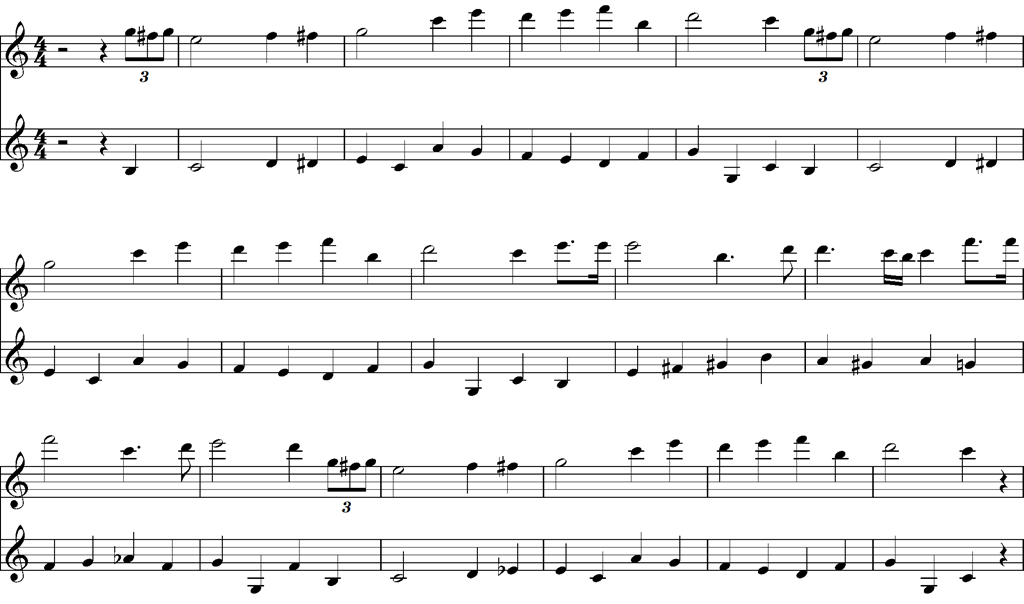
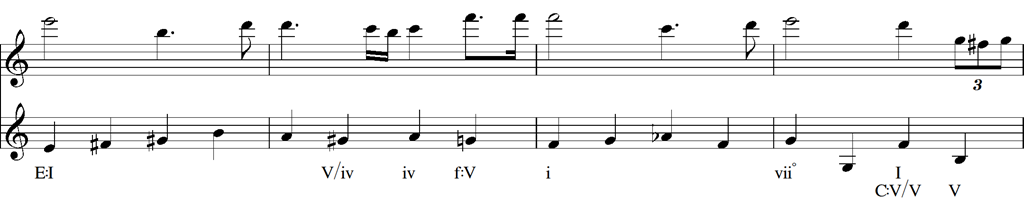
SMB2 Ending

This is a pretty straight forward excerpt.  There is a nice passing motion between the V and IV chord on the third line represented by a bVII, though functioning only as a passing motion.  Also, there is a nice sequence descending from V to ii early on in the excerpt.

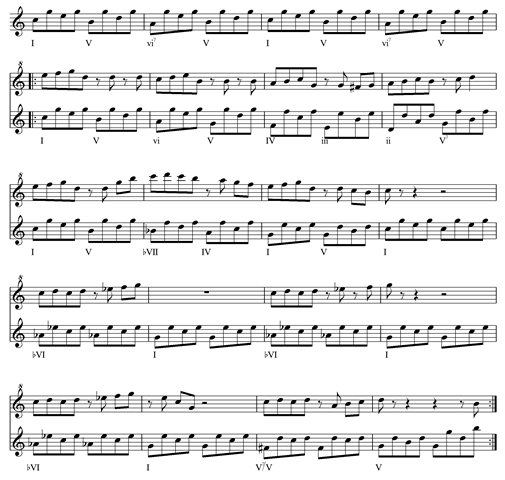
What I want to draw your attention to here is the last eight measures.  Why do you ask?  Well the progression alternating from bVI to I ending in a secondary dominant half cadence is not new.  It may not sound familiar, but with a little bit of chord analysis, you will soon see:

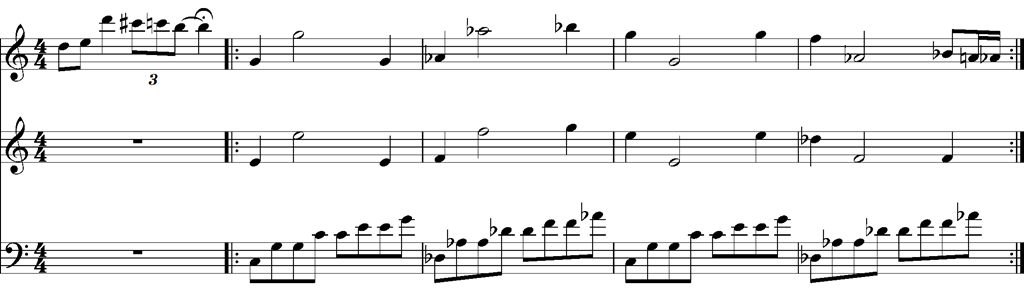
image

This is the third formal section of the original Super Mario Bros. theme.  The exact same chord progression in the exact same key, with the same harmonic rhythm.

Intentional?  Maybe.  Pretty Cool? Absolutely.

Sunday, September 4, 2011

Review: Reale’s “Chaos in the Cosmos”

The first article I want to take a look at was recently published in a new journal based out of Germany.  This music journal ACT focuses on the relationship between music and performance.  Steven B. Reale published an article entitled “Chaos in the Cosmos: The Play of Contradictions in the Music of Katamari Damacy.”

This article was very interesting to me.  First off, the game examined is not one I would consider first for an analysis, mainly because the qwerty, cutesy nature of the games initial appearance.  However, fans of the game will be very familiar with all the contradictions in the game, from the King’s attitude towards his son and his subjects vs. the generally happiness that seems to pervade every angle of the game.

The article begins with an overview of the game’s plot and examination of some of the contradictions that occur in the story and dialogue of the game.  He also uses this point to examine the kawaii culture of the Japanese and how that plays into the game design.

The rest of the article focuses on examining the various music elements of the game.  He traces the use of a particular tune throughout many of the different music objects in the game, and also examines the reinterpretation of certain tunes.  He comments on the juxtaposition of acoustic and digital music throughout and gives us a great overview of the music throughout this game through an analytical lens.

The resulting conclusion of the analysis looks to paint a picture of the games contradictions as it is embodied in the music, from the terrible vs. kawaii, digital vs. acoustic, and overall right vs. wrong.  Steven’s article takes us much deeper into a game that on the surface does not seem to offer as much as is actually there.

Sunday, August 28, 2011

A Blast from the Past

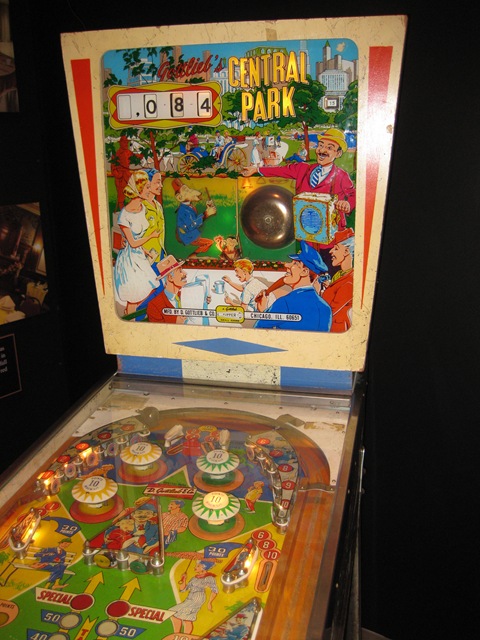
IMG_2414I visited the Orlando History Center this past weekend.  They are hosting a special exhibit called “Games People Play” going through the history of video games.  Sadly, I was disappointed by the latter half of the exhibit.  I was hoping for more detailed exhibits on significant moments in games past.  The first three exhibits were fun though.  They had a working pinball machine from 1966, called Central Park made by Gottlieb.

What does this have to do with game music analysis?  Well not much.  This game has two sounds produced acoustically (not electronically!).  There is a bell that rings every time you score points.  For every multiple of 100 pointes, the monkey on the backboard rings the bell you can see in the picture.  The two bells are tuned very dissonant to each other and both have a lot of overtones.

I was intrigued by the sound of the score reaching 100.  An score-hungry player would be focused on the playfield and the ball so much that he would not have much of a chance to see the score board.  The use of a sound indicator at every 100 point mark gave the player some indication as to his progress in the game.

It goes to show that sound has been used in games very early on as an indicator to the player of an event or situation the player would want to be made aware of.